|
HIV/AIDS Discussion
26 September 2004

I held a roundtable discussion on 26 September 2004 to discuss ways of encouraging actual behavior change through the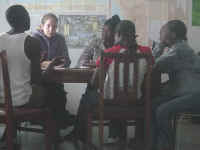 HIV/AIDS awareness campaign in Namibia. The participants were five learners ages 17-21. All are in grade 12 and all are in the AIDS club. The participants were as follows– Male: Freddy and Diogenus; Female: Kornelia, Miina and Kristina. HIV/AIDS awareness campaign in Namibia. The participants were five learners ages 17-21. All are in grade 12 and all are in the AIDS club. The participants were as follows– Male: Freddy and Diogenus; Female: Kornelia, Miina and Kristina.
Although what follows is mainly anecdotal, I think the learners had some good ideas and shed some light on the complexity of the AIDS problem.
SPREADING THE VIRUS
The discussion began with Kornelia telling a story about a friend of hers who got HIV, knew it, but then continued to have unprotected sex. Diogenus confirmed this trend by saying that someone in his village got AIDS and then started sleeping with lots of girls, essentially spreading the virus on purpose. When I asked why they thought these two HIV+ people behaved that way, they said, “They don’t want to die alone.” This means that sometimes people who find out they are infected wish to infect others (misery loves company?). The idea is that they didn’t ask for it, but got it from someone, so they will do the same to others. People who get AIDS lose hope, they’re going to die anyway. So why does it matter? I have heard this concept of not dying alone many times before. My personal impression is that maybe with more anti-retroviral drugs, the virus won’t be such a death sentence and then perhaps they won’t want to kill others with it? The learners concur that a supportive environment or a family with kids will help people to behave better (give them a reason to live).
DISCUSSING DEATH
I asked if it is talked about when someone dies of AIDS. They said that although the elders in the family may know, they won’t tell the children and won’t tell other people. Sometimes they will say they died of something else like a heart attack, even if it is obvious that it is AIDS. Furthermore, if you are suspicious that someone died of AIDS, it is extremely insulting to even imply that. If someone really does die of another disease, such as malaria, it can be discussed, because there is nothing shameful about it. AIDS is related to sex so it is shameful. Miina’s uncle died, clearly of AIDS. She asked her mom why he died, but her mom refused to talk about it. However, seeing her uncle died made it real for her. But her parents were in denial.
STIGMA
Freddy says this trend (of not talking about people who die from AIDS) is mostly in the north (rural areas). He claims that it is different in the towns. The reason is the tradition is stronger here (in the rural areas). He says “Aids is a disgrace disease”. AIDS is not talked about because it is related to sex and the elders forbid/avoid discussion of sex (tradition). Freddy says elders know people are having sex, but don’t want to believe it. They’re in denial.
ACCEPTANCE I asked, Is AIDS better in the towns because they talk about it? No, people are more open about it, more informed, but, as Freddy explained, “That’s what doesn’t make any sense, because most information is in town, all the media. Yet you find an increase in AIDS. You feel as if they’ve accepted it. They talk about it freely, they know its causes, but they just accept it.”
The learners then say a proverb of “AIDS is here to kill people, not dogs.” This means that many people think it’s among us already, so we just have to accept it. It’s here to kill us, so why prevent it? They believe it is a punishment from God. You can’t go against God. (here they are expressing beliefs they’ve heard, not their own beliefs. They say these ideas are prevalent in the rural areas among uneducated people).
TOO MUCH INFO?
Yes, they said in towns, people are constantly bombarded with AIDS messages. But on the other hand, there is not enough info way out in the rural villages. They claim in some places people don’t even know what a condom is.
CONDOMS
Some people believe a condom is like abortion. If you use one, you are killing people (potential babies). “If you use a condom, it’s like you are arguing with God” this is said by people who are not informed. They believe in the tradition. Young people don’t have this belief as much as older people. Other problems are simply that people don’t like using condoms. Maybe in a relationship, they start out using condoms, but then they say, “We know each other” and quit using them. Diogenus added that a lot of people still use condoms incorrectly. Some people think you should use 2 condoms. Others think the lubrication in condoms is spreading the disease.
RELIGION How does religion affect condom use? They all agreed that religion makes the problem worse because there is the belief that you should not stop producing children. Once you’re married you can’t use a condom. Furthermore, elders do not promote condoms b/c they believe it is encouraging young people to have sex. They think if there are no condoms, people will be afraid of pregnancy and not have sex.
ABSTINENCE
Is abstinence realistic? No. They say the more they hear not to have sex, they more they ignore the advice and want to have sex. Freddy thinks the elders just want to make themselves believe its not happening, even although they know it really is. Churches just promote abstinence. Learners says very few (1%) of people are virgins at marriage. (therefore this is not realistic)
AIDS MESSAGE
Message should be, “Use a condom when you are ready to have sex.” They say that if you give condoms it doesn’t really encourage sex. People want to have sex anyway. It’s not the first time they’re hearing about sex. But they will feel better if they are given condoms, feel like they are being protected.
ELDERS
They think it would help if elders were more accepting of the sexual behavior and promoted condoms. Freddy says if elders see you with a condom “no one will sleep in the house that day” (hell is raised) Many indicated if their parents saw them heading out, gave them a condom, it would be helpful. They all expressed a wish for more open attitude and behavior, although there are many cultural barriers to this. They wish parents and elders were more realistic and accepted that young people had sex. They think it will be better if they grew up with expectation of protected sex. Feeling comfortable with condoms would help. Instead, the elders freak out. He g ives the example of watching tv with family and an AIDS advert comes on. Everybody gets really nervous and uncomfortable watching it together. Lots of tension. Some learners indicated that they had discussed sex with parents. Parents just said abstain, b/c condoms are not 100% safe. Again, they wish their parents had discussed condoms.
Should there be marketing aimed at elders? For example, a campaign to tell parents to talk to children? They said yes, maybe that would help, but again, traditions are hard to break. But they say that many parents are also not informed about AIDS. Even elders are getting infected-a lot of them are having sex.
The learners indicate that since they have grown up with AIDS, and knowing about it, s they will behave differently from their elders. They plan to discuss sex with their children.
Diogenus says kids can also teach parents. He gives the story of his father. His father has two wives, one up here, and one in Windhoek. One time his father came home and Diogenus made a decision to tell his father about AIDS. His father just shouted at him and said, “I am going to die anyway. I am just waiting for Jesus to come.” He approached father again, later, and father agreed to divorce second wife.
Men like having many wives. A man will have a house at Oshakati and work in Walvis Bay. He will have a wife in both places. They don’t go with their family. The wife at home will even get another husband. (I think they use husband and wife interchangeably with girlfriend/boyfriend). The kids mentioned that this is a big problem-families being separated due to jobs in different locations.
Kornelia ‘s family has also discussed AIDS. The elder sisters talked to the whole family about AIDS. The talked about it because a cousin got infected and died, and they wanted to take action. Kornelia says her whole family changed their behavior.
FEAR
They say that seeing people die of AIDS will cause people to change their behavior. Freddy says, “We hear about AIDS every day, but we have no fear of it. Like, oh man, this thing is really killing people. If people really get to see people affected by AIDS, like, here is how it is destroying people and families, then they will have that fear.” Seeing this will cause people to change–if they realized people were dying of AIDS every day. People going public with their HIV status will help.
How can we make people afraid of AIDS without discriminating against people who have AIDS? (no real answer. They all were blank.)
Miina says they should be close to people who are really sick of AIDS. If they see how sick they are, it will really cause them to change their behavior. Keeping AIDS hidden and secret makes people not afraid. (Freddy gives an analogy of a forest with lion in it. If he goes in, and people see him being killed by the lion, they too will be afraid to enter. However, if Freddy goes in, and just disappears and they bury him quietly, people will con HIV to go into the forest and be eaten by the lions. He says we should show his severed body parts and then that will warn people not to enter. It’s a valid analogy, I think.)
Furthermore, there is currently a lot of messages showing healthy people who are HIV positive. This is to prove to people that you cannot “see” if someone has HIV. Yet the learners say that seeing healthy people with AIDS makes AIDS not very scary. They think they should show both sides. In the beginning you are healthy, but later you end up really thin and sick.
Freddy says he once saw a documentary of people dying of AIDS in Kenya, and from the day he watched it, he wanted just to stay away from sex. He was so frightened. The documentary showed how bad it was. I could tell Freddy was even getting really emotions as described the film.
Kristina mentions a guy who went public in 2001, a really sick skinny guy. He made an impression on her.
They talk about a special ward in the hospital where all the HIV people are. Freddy describes a time he saw them, b/c he broke his arm and was at the hospital. He starts doing impressions of suffering AIDS people, and imitating what they say. Impressions are that people with AIDS are angry. Mad at the world. They say the anger is caused by shame.
All of the learners described seeing AIDS first hand, and that that is what made it real for them.
SPIRIT
Freddy says he has the attitude which he calls his “spirit” or “vision” that he will never get infected. He says this is not the “It won’t happen to me” attitude but rather “I won’t let it happen to me.” He says he will not do anything that will allow him to get AIDS. He says this vision is what will stop him from doing stupid things. He talks about drunk friends at clubs that will just meet a girl and go have sex. They have regrets the next day but then do the same thing again that night. They know about HIV, but that knowledge alone doesn’t stop them from engaging in risky behavior. Freddy says the problem is that they don’t have that “vision.”
THE MOOD
The boys both say that “The mood”( eg-sex drive) is one of the reasons people engage in risky sexual behavior. If one is in the mood, and there are no condoms, even although he knows about AIDS, the feelings will override rational thought. But, Freddy counters, the vision can make a difference. This vision is the “brake”. They emphasize that it is not enough to just know about AIDS. You must have an internal, personal promise to yourself that you will not get HIV.
How can we give people that vision? That brake? “Take him to the hospital, show him the pleasure he wants is going to lead to this suffering.”
Again, they say the image/picture of AIDS will also help. Images are better than words. (For example, if you’re in the mood, and then you remember a picture of a person dying from AIDS, that will put you out of the mood moreso than just remembering being told about AIDS.)
ALCOHOL
Alcohol is another huge factor in people having unprotected sex. I asked if there was any hope or solution to the alcohol problem. They all shook their heads and indicated clearly that they saw no hope. Alcoholism is ingrained in their culture. They say there is nothing you can do to prevent people from drinking. Then, once you’re drunk, nothing will help, not even the vision. Alcohol also leads to rape. When girls are drunk, they are very vulnerable.
Good role models might help. If someone you admire doesn’t drink, it might encourage you not to drink. (Of course, then, vice versa is also true-you might admire someone who is an alcoholic.)
TESTING
Is testing helpful? Can going through the process of being tested encourage people to be serious about AIDS? Yes, it will help make it real. The counselors give good advice and information.
PROBLEMS WITH CURRENT AIDS MESSAGE
They complained of a lack of information and therefore a lack of awareness about blades and needles. For example, they use needles to take out thorns and will share them without thinking twice. Similarly, they share blades to shave heads. But there’s no awareness about that. They complained of too much focus on sex. Too much of the same message.
|