|
The Elephant Ballet
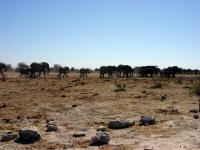
It’s a Saturday afternoon. All is calm at the Arcaro Rest Camp; the house is cleaned and put back in order after two weeks of vacations and visitors. I made cinnamon rolls for a late breakfast, we’ve been reading a new supply of New Yorker and Smithsonian magazines from Zac’s grandparents, and thanks to a digital thermometer received from Zac’s mom, I now know that the temperature is 81.3 degrees F outside (ah…winter in Namibia). We’re living a life of luxury—surrounded by our books, stockpiles of food, and nifty gadgets. Yet a sense of dread hangs over our house, some impending doom lurks in the numbers on the calendar… Yes folks, it’s time for school to start again. Somehow our whole month of vacation has dwindled away to nothing. In an attempt to procrastinate on my lesson planning, to clutch at past joys fading away, I’m going to tell you about our last week of vacation, a time of elephant ballets and encounters between traditional and modern life. Namibia is a country of luck. As we learned on our trip to Brandberg Mountain, where all planning and preparation is futile, luck takes over and things have a magical way of working out. So it was lucky that one of Zac’s roommates from college, Craig, and his friend, Ari, met our fellow volunteer Jacque at the same backpacker hostel in Swakopmund (the coastal “resort” of Namibia). Craig and Ari had been doing botanical field research for Craig’s uncle in South Africa for three months and had rented a car and were now traveling through Namibia, planning to spend three days at Etosha after Swakop. Jacque gave them our cell phone number, Craig called us, plans were made and Tuesday evening we welcomed Craig and Ari as the first visitors from home to the Arcaro Rest Camp. Early Wednesday morning found us cruising down the unmarked, dirt road to the northern Etosha gate in a white corolla, expertly driven by Ari. We saw all of the usual grazing animals in the large veldt preceding the forested area of the park and it was looking to be a typical visit to Etosha. However, on the Stinkwater loop that diverges from the main road, we came around a small bend and into view of an enormous butt. At first I thought it was an elephant butt, but elephants butts are quite saggy and wrinkly, whereas this one was relatively firm. By this simple process of elimination, we quickly determined that we were gazing at a rhino butt. Now, rhinos are one of the big five, and you’re quite lucky if you see one, especially this close. However, rhinos have their hazards, as they are known to be quite territorial and fond of charging. Furthermore, the rhino was bigger than the corolla. Nevertheless, we kept slowly creeping up on the rhino, who was sauntering down the middle of the road, with the contingency plan of “throwing the car in reverse and flooring it” should the rhino decide to charge. Eventually the rhino moved off the road to eat some grasses, still seemingly unaware of us, and we followed beside it for quite some time. But when it started to look at us in an annoyed-rhino sort of way, we decided to keep going rather than be mauled. A little before lunchtime, we stopped at a water hole close to the Namutoni rest camp. There were about 8 different vehicles there, all with the engine cut and white people inside looking intently at a completely deserted water hole, some with binoculars. My first instinct was that there were lions nearby, but after perusing the area with our binoculars and seeing absolutely nothing, I decided that all these people were simply insane. We were just preparing to leave, when there was some commotion to the left—and out of the bush came a long line of elephants, jogging eagerly to the water hole. All 18 of them lined up on one side, facing all the cars, and enthusiastically partook of the refreshing water. I felt like we were watching some sort of performance—I kept waiting for a voiceover to start explaining the social structure of the herd or something. After a relaxing, greaseful lunch at the Namutoni restaurant, we headed back out, with the plans of camping at Halali (the middle of the three rest camps) that night. It was an uneventful stretch of road, but we did see many birds that we hadn’t seen before during Solomo’s 100km/h death-drive through the park. We also saw a spotted hyena guiltily lurking around a large exposed rib-cage. The car evidently frightened it, because it took a large bone in its mouth and walked off into the bush. We reached our destination of Halali around 5pm, chose a camping spot, pitched our tents, then walked out to the camp’s own waterhole. The waterhole was located below a dolomite outcrop that supported benches for the tourists to sit on, and I had the feeling of being in an outdoor amphitheater. We arrived at the waterhole at dusk; the cloudless sky was just turning a deep blue while the horizon seeped glowing orange. All the visitors sat silently, with a reverential hush that reminded me of the part in the church service right after communion but before the collection. Like earlier that morning, everyone was intensely looking at a completely lifeless waterhole. Once again, I felt that the joke was on us—that all the animals were hiding in the bushes looking at us through their binoculars. But then the show began. Act 1 (Scene 1): As it grew darker, a flock of birds descended on the water hole with chirps like the opening symphony. (Scene 2): A herd of 10 elephants came lumbering out to the water. The lead elephant ran around the water, sending the birds noisily flying. The elephants circled the waterhole and engaged in their water-drinking charades. One baby elephant had a very itchy trunk, and kept rubbing it up against one of the rocks. Another elephant sauntered onto a small isthmus reaching into the center of the pond and defiantly deposited several large plops of dung at the water’s edge. A group of elephants were drinking side-by-side when an elephant, walking backwards, stopped right behind them. Then one of the drinking elephants tried to back up, bumped into the elephant behind him, resulting in a small skirmish in which all the elephants clumsily bumped into each other (bumper elephants). Eventually, one by one they started to walk off, the same way they came. One very thirsty solitary elephant loitered much longer than the others, drinking, drinking. (Intermission) We walked back to our campsite to cook supper, amazed at our luck. Craig described the elephants as performing an abstract ballet, and indeed, it was just like that. I felt like we had witnessed an extra, director’s cut scene from Fantasia (now available only on DVD). Act 2 (Scene 1): It was now completely dark as we walked back to the waterhole. I expected to find only a small audience, but there was a large crowd, this time watching two rhinos, which were exiting just as we arrived. (Scene 2): They were soon replaced by a hyena that nervously skulked around the waterhole, drinking hesitantly. (Scene 3): Then the two rhinos came back, and the hyena crept back into the bush. I felt like I was watching an in-and-out-of-the-forest lovers’ intrigue scene in a Shakespeare play. Act 3 A lone elephant entered the stage, causing the two rhinos to reluctantly leave. It was soon followed by a line of 22 elephants trotting into the spotlights that illuminated the waterhole, creating an image of football players entering the field for their Friday night game, with the biggest one coming last, like the star quarterback who bides his time in the spotlight. This final scene, with so many dancers, had a much more complex plot than the previous scenes. There were four elephants contending for the best water—the place where the fresh water poured into this man-made waterhole. They would push each other with their trunks and legs in order to maneuver into the best position for access to the water. Then a young elephant decided to go into the water, to try its luck from that angle, only to find itself blocked and unable to get out of the waterhole. Fortunately, a compassionate larger elephant reached its trunk around the body of the small one giving it support and enabling it to climb out of the water. Off to the left, two elephants engaged in trunk twining and pushing, while another elephant kept walking around the group, seeming to supervise. Another elephant stood in the middle of the pond, thrashing its legs and trunk about, evidently trying to wash off a few layers of dust. Then a small elephant had a very itchy leg, and was undergoing all sorts of antics in order to relieve the irritation. A few elephants seemed aware of the audience and would promenade in front of our elevated position, proudly displaying their large flappable ears and dexterous trunk. Gradually, the elephants exited, stage left, in a slow progressive line, leading up the path and back out into the bush. Finally, only two elephants remained, and seemed quite reluctant to leave, but an elephant call beckoned them from the forest. I felt like there should be applause, after such a beautiful performance, but the watchers, few remaining now, continued to observe the deepening night in respectful silence. Thursday morning at Etosha the sun rose to birds instead of chickens. We were soon on the road again, driving back towards Namutoni, on a stretch of road that ran along the southern edge of the Etosha Pan (the salt pan that is Etosha’s namesake). We were out of the park before noon, and we headed south on the B1, towards Tsumeb. Our intensions were to see the only two natural lakes in all of Namibia, which are both located just north of Tsumeb. By following signs down dusty roads, we eventually came to Lake Guinas—a clear, deep (100m?) lake surrounded by high limestone walls situated in the middle of nowhere. There were several abandoned buildings and machines, which had been used to pump water out of the lake for irrigation. The whole area had a ghost-town feel, and I quite forgot where I was for a while. Next, we headed to Lake Otjikoto, which was a similar lake but just off the main road and was consequently turned into a tourist attraction. It is purported to be about 55m deep and full of German weaponry and ammunition dumped there when the army retreated in 1915. When we were there, there were two separated groups of scuba divers, one coming out and one going down, evidently attracted by a lake with cool stuff in it and perhaps also the rare psychedelic fish that exist only in these two lakes.
We arrived at Jacque’s in the afternoon and although there are a total of 16 people living at the homestead, only 5 or 6 were around when we got there. Three young girls (Anna, Katrina, Beata), who go to a private school in Ondangwa and consequently speak English very well, were our primary companions for the first few hours. There were a few older boys around the place as well, and they showed us the garden and fruit trees. Then the girls demonstrated how they pound mahangu (the staple grain) into flour. There is a special pounding hut with holes lined with wood in the floor and piles of mahangu on the floor (which explains why there is a decent amount of sand in the oshithema). It was really beautiful to see and listen to the girls pounding. They take great pride in their ability to pound three at a time in one hole—a feat of rhythm, strength, and coordination that Jacque and I proved to be quite incapable of. After the pounding demonstration, Beata, the 10 year old girl wearing a small, faded black skirt and no shirt, began to cook oshithema for us. She first kindled a fire between three large rocks in the cooking hut (a hut with a thatched roof and no walls). Then she took the big pot out of the sand and scraped out the leftovers of the last pot of oshithema. Then she added water and placed it on the rocks, above the fire to boil. When it was hot, she added first some maize meal, then later the mahangu flour. She stirred the pot with a large cooking stick that was stored in the roof of the hut. When the porridge (as they translate it to English) was the consistency of thick wallpaper paste, she put it on a plate and covered it to keep the flies off. The girls insisted that we could not eat plain oshithema, so Ari got a can of tomato and onion mix from the car, and heated that up over the remnants of the fire. Once it was warm, he poured it into a traditional clay bowl that one of the girls had produced. Then we ate. Because the girls wouldn’t eat with us, Laura, who is the model Volunteer of the group, demonstrated how to take a small blob of oshithema and roll it into a ball between your fingers, then dip it into the tomatoes, pop it into your mouth, move it around in the mouth a bit (don’t chew!) and then swallow. We all followed suit, and we all agreed that this was the best oshithema we’d ever tasted. It didn’t taste good, but it had a neutral taste, and so it wasn’t bad. For Zac and I, it was only our third time to eat oshithema, while Laura ate it every day with her family. Craig and Ari did remarkably well with the local fare and between the ten of us, we managed to eat half a plateful of oshithema. Yum yum. While Beata was cooking, Craig went and got his video camera. He let Anna look through it while he controlled the zoom. When he zoomed in, Anna would thrust both hands in front of her as if what she saw through the camera was in fact right in front of her. She did this again and again, while I nearly died laughing. Soon it got dark, and we all headed over to the other side of the house where there was a light. They produced chairs from somewhere and we all sat around, some playing euchre. They moved the TV outside (this is one of the wealthier families), a kid brought out a table with dominoes on it, Jacque was requested to make a chocolate cake, someone passed around a bowl of grapes, and more and more family members came home, each greeting each one of us as they arrived. Later they produced the oshithema cake, which is basically oshithema baked with a little salt and sugar. Not long after that, Jacque produced her cake, which was all chocolaty goodness and no sand. Soon it was late and dark and cold and we decided it was high time to head back to the Arcaro Rest Camp. Several family members paraded us out to the car, and we promised to come back again. Two guys ran in front of the car to show us the way to the dirt road, then we were on our way home. Once in the car, I began to reflect on our experiences of the evening. I thought back to when I first came to Namibia and I experienced severe culture shock—horrified that a whole country was living in huts and walking around like it was normal. But after acclimating for seven months, I am now able to fully appreciate the richness of their lifestyle, their traditions and culture. I am still far away from my overly-romanticized view of developing nations that I held after my 10 day trip to Honduras when I was 15, but I could now look at their existence in a realistic context. I remembered a conversation I had with our host-sister during training. She was asking me about universities in the U.S., saying she was hoping to be able to study abroad some day. At that time I was very much in my anti-hut phase, so I arrogantly joked with her saying if she left Namibia and went to America, she would not want to come back. “Oh no,” she responded, “I would come back. I love Namibia.” It was the first time since my arrival that it occurred to me that people could actually like their lives here in Namibia and not naturally want to move to the “land of opportunity and riches.” Since then, I have gradually come to greatly appreciate and enjoy Namibia—both the land itself and the people who inhabit it. Craig and Ari left early Saturday morning to begin their drive back to South Africa, and soon thereafter to fly back to the U.S. I didn’t envy them. I mean, I will come back. I love America. But for now I’m enjoying life here in sunny Namibia. Love, click here for more photos of Etosha or for pictures of homesteads
|

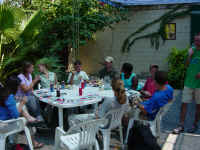 On Friday we all drove up north to Ondangwa and Oshakati, where Zac and I showed Craig and Ari such important landmarks as the Shoprite where we by our groceries, the pink bank where we magically get money, the Ondangwa Rest Camp where we meet with our friends on Saturdays, the Ongwediva TRC where we use the computer lab, the really nice (and expensive) Spar grocery store where we can buy such rarities as red meat and mozzarella cheese, and Nando’s, where we went during our training in Omege to eat some good food. We met a bunch of our friends at the Ongwediva teacher’s college, then headed to Nando’s for lunch. After lunch, we all went to Jacque’s homestead so that Craig and Ari could see the inside of a traditional house and also sample the Owambo staple food: oshithema!