|
Sacrificed Ice-Cream
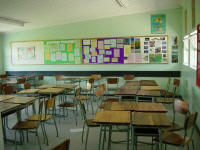
From Sera: It has been 3 months since we left our homes in America. We are now settled into our new home at Ekulo Senior Secondary School, and we are finally teaching. In our cultural training, we were warned that the concept of time is different here, and that things take a long time to happen. I thought, “ah, how nice, a relaxed pace of life for two years will be fun…” What I didn’t realize at that time was that while things were taking a long time to happen, I would be stuck in the teachers’ room doing absolutely nothing from 7am to 1pm, while no one talked to me or told me what was going on, or what I should be doing. It was not fun. So that was my life at Ekulo from Jan 9-17. But on the 20th, classes finally started and all my frustrations and annoyances subsided as I looked into the fresh, eager faces of my learners. The kids here are really great—very well disciplined and ready to please. I think I will have a hard time readjusting to city schools in America when I come back. Here, my every wish and command is immediately met with “yes Miss.” One day, I had the learners write down what they wanted to do in English class this year. Many of them insisted that I give them a lot of homework and one girl even wrote, “you must give us a test every Friday.” This was countered by a 9th grade boy who wrote “you must give us gifts like sweets, chocolates and ice cream.” I told him, “I don’t even have ice cream here because it would never survive the hour long taxi ride from town. I left all my ice cream in America as a sacrifice to come to Namibia just so I could teach you English, and you’re telling me I should give you ice cream?!?!?” Another common trend was their desire for books. They really want to read books and go to the school library (which is mysteriously never open). I saw the school library when we came here for “on the job training” in November. It is a very sparse library compared with even the poorest library in a school in the states, but it is surprisingly abundant for this country. I really want to make it one of my projects to get some young adult literature for these kids. Somehow. For this year, I am teaching grades 9 and 11 English. There are three classes of each, and the number of students in each class ranges from 21 to 35, so I have about 200 learners altogether. I am convinced some of my 11th graders are older than me. This school operates on a 7 day cycle, so every week is not the same, and the daily schedule is never the same either. The timetable is very complicated, which perhaps explains why they still haven’t finished it, and keep giving us temporary schedules every day. If they ever complete the timetable, I will be having 45 out of 49 periods per 7 days. Luckily, I have my own classroom, so I can make it a little haven of efficiency and order. In my room, I put up 2 bulletin boards about HIV/AIDS, 1 about the environment, and one section has posters that I had my learners make about how English is used in their own lives, Ekulo, Owamboland, Namibia, the world and the media. I will also have some of my learners make some art to decorate the room with, but I must buy them supplies first. One interesting thing about living on the same campus as the learners is that several of them come to visit us every evening. We are grateful for the company since none of the teachers have taken much interest in us. We show the learners our pictures and maps and tell them about America, and how it is winter there—and then we have to explain how nobody has goats or grows mahangu, and how there are many forests because no one needs wood for fires to cook because we have stoves (“But Miss, what about the people who don’t have stoves?” “Everyone has stoves.” “Oh!”), and how most people have jobs and cars, and all the roads are paved, even some of the driveways, and how we speak English even at home, and how school is free, and everyone is a day-schooler and buses pick people up if they live more than 15 minutes away …etc. All in all, I think I will really enjoy teaching here, mainly because the learners are so good—they make it all worth it, even giving up ice cream for two years. We are very lucky to be placed at such a good school and in such a nice house. Many of the other volunteers are not so fortunate, and they will have a very difficult two years. We are calling our house The Arcaro Rest Camp and have given the other volunteers an open invitation to come anytime for some R&R from the homestead. Inda po nawa, kala po nawa. (Go well, stay well.) Love, Sera Hello Everybody, This is from Zac: Well, Sera and I are finally volunteers, training is over and we are on our own in Africa. We made a lot of good friends with our fellow trainees and for the duration of training they, and being in a new environment with them, have defined our experience. Newly minted group 20 is now spread all across Owamboland, and we are all now full time teachers in some school we didn’t have the faintest idea existed only three months ago. So, Sera and I have been placed at Ekulo S.S.S.; it is our final destination for two years. I think that I will be pretty happy here. Firstly, our house is beautiful; we have a well-appointed shower (with hot water!), a deluxe flush-style toilet, quite regular electricity, and a modern kitchen wi As far as the whole teaching aspect of this gig is concerned I am taking it day by day. You know, I actually handle standing up in front of a classroom full of Namibian high school students pretty well. Only the very first time I went in to teach the kids was I ever nervous, and this was during “model school” where I had students to practice on before the real thing here at Ekulo started. I just get up in front; speak slowly and loudly using my Tang Soo Do voice and the kids magically turn into my students. The hardest part for me has been drafting and designing the lesson plans for each day. I am definitely a novice teacher so I am learning everything from how to properly write on the chalkboard (spacing everything out maximize both space and clearness) to gauging the best way to explain various topics to planning the right amount of information to cover in a period. Generally though, I feel that this will be a very fulfilling job. I really couldn’t have hoped to get brighter students. So far they seem to speak English well, have good behavior, and are highly motivated. There are of course some exceptions but it must be understood that other schools here are completely different: at least one of my colleagues (from a previous group) said he spent literally a solid month teaching basic multiplication to students in high school. On the other hand, with my students, I’m pretty sure I will get to teach some of them calculus. It will be challenging and I’m sure that more than once I will wish I remembered my college math classes a little better. Another thing that is going to be difficult for me is that I will be teaching at 98%. There is a seven-day rotation here, with seven periods every day. So there are a total of 49 periods in the rotation, of which I will be teaching 48. In other words, I will get one free period every seven days. (The percent recommended by the Peace Corps is 70%, in order to give us time to work on other projects) So, in addition to teaching two 11th and two 12th grade math classes I will also teach one 11th grade and one 12th grade physical science class. The problem is that there are a few missing teachers here and the principle asked me to help fill in the gaps. (When I say missing teachers I mean it, some of the kids will literally go to a classroom for class several periods every rotation and sit in there with no teacher; they simply will not be taught that subject this year). On the bright side though my laboratory classroom is surprisingly well stocked. It’s ironic that I have to give out decrepit books (one for every two people, if we are lucky!) when I have a nice oscilloscope sitting in the back room. I think I will manage just fine though; overall Sera and I are extremely fortunate to be here at Ekulo. Our principle is organized and friendly, the other teachers are nice (if somewhat indifferent), and we live in a fine house less than five minutes from our classrooms. Love, Zachary click here for more pictures of our house or Ekulo or the teachers or the learners
|

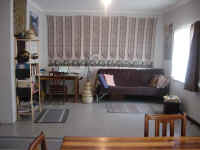 th everything today’s chef could need including a stove and a refrigerator (you know, to keep things cold). Actually, it is a pretty nominal two-bedroom house, but here in Namibia compared to most people’s houses it is a regular castle. We live in a little cluster of teacher’s houses on one side of the school grounds. Our house is built for two couples or four single people, but we are living alone. There is a large communal living room where there is a couch fashioned out of a bed, a large wooden table where we eat and work, a smaller table, which we have the laptop set up on, and four nice chairs. Off of this room we have the front door (facing SSE), the communal kitchen, and the door of the hallway to the toilet room, shower room and two bedrooms on our side of the house. So far we have invested in a bookshelf and a floor lamp and we have tried hard to decorate the walls with cloth and posters (this serves a double purpose as the paint on the walls is in pretty poor shape). For our first house as a married couple I think Sera and I have done quite well getting the place up and running.