|
August Holiday to Windhoek & Swakopmund
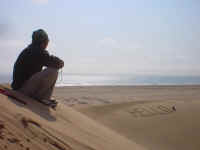
Our two-week break between the second and third trimesters is almost finished. We went to Windhoek for four nights and then over to Swakopmund for two nights. The stay in Windhoek was ostensibly to facilitate our mid-service medical exam. But we also took the opportunity to explore the city and do touristy kinds of activities since we were stuck there anyway. As always our little trips are a veritable fount of stories to send back to the denizens of the first world, so… Tuesday morning we wake up early, eat breakfast; grab our bags and head out to the road. Yep, to the road we went, and after a 15-minute walk we were there. I guess it would be the Namibian equivalent of going to the bus station. We didn’t expect fate to make us wait too long for our ride, after all this is the Main Road, the sole north-south artery in the country, the thoroughfare through the heartland of a sovereign nation twice the size of California. 50 cars and 1.5 hours later our transport arrived: a small pickup truck (aka a “bakkie”) stopped to give us a ride. We bid adieu to the three kids who had nothing better to do than sit and stare at us from 15 feet away and then we were off. Zac sat in front with the driver, a certain man named Fisher whose ethnicity was as difficult to ascertain as his source of employment, while Sera sat in the back and alternated between dozing and reading. At Tsumeb, Fisher picked up his boss, and Zac moved into the back with Sera. We stopped in Otavi for petrol and a pee, then again later in Otjiwarongo where Sera made the first of our holiday purchases: a half-canister of Pringles Salt-N-Vinegar chips for N$10. Ah the South, where you can have luxuries abundant if only we weren’t on a volunteer budget. Those chips cost about 0.7% of one of our monthly salaries. While in Otjiwarongo we received a voice message on our cell phone from our Meme from training. She had apparently stopped out our school on her way back north from Windhoek, and also wanted to invite us to a wedding on Sept 6. We panicked. We have only been to two Namibian weddings before, and they were tolerable enough but something we definitely didn’t want to repeat. Most people go to weddings to visit with people they haven’t seen for a while and eat good food—two things that don’t apply to us with weddings here. The food is best avoided and we just cause a spectacle with the people. We climbed back in the bakkie and plotted how to get out of the wedding. We arrived in Windhoek at 3pm, a mere 6 hours after our departure time. Our driver kindly dropped us off at the door to our hostel and only charged us N$100, half the price of normal bus fare. The hostel was called Trampers’ Haven and was “Christian themed” according to our guidebook. Because we apparently started calling too late for our reservations, we couldn’t get into the normal places that the Peace Corps has accounts with, so it was the only place available. Even then, we didn’t get a double room for ourselves, but were being accommodated in one of the dorm rooms, which our hostess assured we would have to ourselves. The place had beautiful wood floors and bunks, brightly painted walls (ours were purple), high ceilings and large windows. There was a bathroom connected to the dorm with one toilet and two showers with transparent yellow shower curtains. There was a small communal kitchen with a fridge, range, and best of all—a microwave! When we were checking in, the hostel was mostly deserted and the only thing “Christian” about the place was the fish symbol on the sign. Although we have been in Windhoek two times prior to this, this was our first real chance to walk around and explore. So we headed out, armed with our tourist map. There are a lot of white people in Windhoek and even a few other nationalities like Chinese and Portuguese. As far as I can tell, the city is still pretty segregated (from the apartheid era)—with the white people living in nice large houses in Windhoek proper, and most of the black people living in Katutura, a “suburb” of Windhoek, where the small houses are made of sandy cement blocks and bunched close together. Most of the business owners in the city seem to be white people, while blacks are employed as the workers. However, I think the government is mostly black as well as a large portion of the education sector. So we wandered around and found the Peace Corps office and medical office, as well as the place where most of the other volunteers (who made reservations early) were staying, and a grocery store in a mall. The city was pretty deserted and most things were closed because it was a holiday, Heroes Day. Since it’s still winter here, it gets dark around 6pm, and we didn’t want to be wandering around in the dark lost, so we bought some cans of tomato soup and tramped back to the haven. As we came into the courtyard, the hostess nervously greeted us and informed us that 14 Italians had unexpectedly come to the hostel and since the other dorm room only accommodates 10 people, four of them were now in our room. We received the news gracefully and went in to see for ourselves. Sure enough, there were Italians and backpacks strewn everywhere. We had a nice conversation with one of the Italians conveniently named Sara. While we were visiting, the hostess came by, probably to make sure we weren’t having any territorial disputes, randomly flicked the lights on and off and left again. We were beginning to realize she was a bit nutty. Sara told us about the two-week tour they’d done through Namibia and all that they had seen. We mused over the irony that in two weeks she saw more than we have in 10 months. We grumbled about the Peace Corps leave policy and lack of money for travel. We learned that in Italy, from the first year at a job, a person gets 27 vacation days per year. You all are living in the wrong country and we’re definitely volunteering with the wrong organization. Grumble, grumble. The next day, we went to the medical office at 8am to receive our schedule. The highlights of the medical were a TB test, blood work, a dentist appointment, physical exam, and best of all—we got to poop in a cup for three days in a row and carry it to the lab in the mall. Good times. The dentist appointment was actually the most enjoyable because the fluoride treatment tasted like apple pie filling and the dentist sanded some cement off my front teeth that was a vestige of my braces, ten years ago. Medical only wasted about a day, so the rest of the time was ours. We did some shopping, hung out with our friends who were also there for medical, and generally spent a lot of money and time. We saw two movies and ate a lot of pizza and other “fast food.” After two nights at the purple-walled Haven, we switched to a place called Puccini Guest House, where we had our own room that appeared to have been the trial set for Trading Spaces—as the walls were several hues of marigold, or mustard, or whatever euphemism they use for horribly-ugly-yellow. There was a shower and toilet literally in the room, with only a circular curtain around the shower and a little partition in front of the toilet that didn’t go quite far enough. On Thursday afternoon we found out about a workshop that Schoolnet was hosting. Schoolnet is an organization that refurbishes computers and donates them to schools in addition to hooking them up with internet. They have donated 3 computers to our school. So early Friday morning we met with another volunteer, Seth, and took a taxi out to the Katutura Community Art Center, where Schoolnet has a workshop in the basement. We had a nice little session and at the end somehow got them to donate 20 computers to our school. We’ll see. Friday night, ten of us went out to this very nice Portuguese restaurant to celebrate the birthdays of Anand and Seth. To my infinite delight, the table was laden with bread and olives. Before I even ordered, my plate was covered in breadcrumbs and olive pits. Everything on the menu was expensive and kind of weird, so I just ordered a Greek salad. It too came with olives. At the end of the meal, I had consumed a total of 32 olives and only had a slight stomachache. The restaurant also had a live band, which played some Frank Sinatra songs. For the ten of us, the whole meal cost about N$750—about US$100. Sounds like a good price for a fancy meal, but for us it was a small fortune. After the restaurant, we went down the street to Joe’s beerhouse, an interesting outdoor restaurant/bar that had way too many themes going on. Everything was African hut style, with thatched roofs over the tables and stick fences, but then there were street signs, license plates and fake memorabilia nailed everywhere. Bar stools were wooden toilet seats with a pail attached for you to deposit your peanut shells and other trash, then there was a toilet tank attached to one of the trees. The bar itself was very beer-mug oriented. I’m not sure what they were going for but whatever it was they overdid it. Since it was about 11pm, it was quite cold and because I have no sense of fashion, I was huddled up in my hooded sweatshirt entertaining myself by drawing up a critique of the décor. A lot of people started leaving, particularly some good-looking ladies who were being hit on by drunk older men. Since I was sitting a little apart from everyone, one of these drunk older men decided to talk to me. His witty come-on line was something to the effect of me being a monk (because of the hood—so clever this one) and Gregorian chant, and some other stuff. I decided to play along for a while, to entertain my friends who were getting quite a kick out of it. But I was really quite sleepy and not fit to match this sharp-witted fellow (or not inebriated enough) so I gradually tapered off the conversation by taking a vow of silence. Saturday morning we met with Jacque and Anand and took a bus out to Swakopmund—the German coastal resort. During the 3 hour ride, I watched the landscape change from tall green trees and yellow grasses to sand and shrubs as we passed through the Namib Desert. As we neared the coast, the air became decidedly damp and cold. The sky was overcast. Swakopmund is known for its fogs, which are caused by cold moist onshore winds meeting with the dry heat of the desert. The moisture from the fog supports the “complex ecosystem” of the Namib dunes. The taxi bus thing dropped us off at our hostel (more like a bed-and-breakfast)—a place called the Alternative Space. It’s a small hostel built and run by an architect (Frenus) and his wife (Sybil). The rooms were large and sparsely furnished, but with ample art (mostly nudes and black and white photography done by a friend of theirs named Mitchenson) on the white cement walls. It was like sleeping in an art museum. We met Jacque and Anand at a little café for lunch, where I had cheesecake and Zac had quiche and then we split a chocolate chip muffin with cream for dessert. We can’t get stuff like this in the north. Our holidays are as much about food now as about seeing new things. After our repast, we waddled down to the ocean and breathed the salty air, fresh and cold from Antarctica. We admired the beach houses and picked out which ones we wanted to buy after we get out of the Peace Corps (a luxurious mansion here would only cost about US$200,000). Then we headed back into town and looked at all the shops that were already closed or closing. We did a lot of window shopping and planned what we wanted to do the next day. We had dinner at a nice German restaurant where I had pork chops and dumplings with gravy and some red cabbage stuff. Zac had asparagus with potatoes, and salty slivers of game. Apple strudel for dessert. Swakopmund is even whiter than Windhoek and very German. Again, there is the white section and black section—although not officially, but that’s how it is. Swakop is very touristy and most people go there for the December holidays because the cool wind keeps it a comfortable temperature even in the summer. There are informal markets everywhere selling “African” things that aren’t really African in my opinion, but they’re what a tourist thinks of Africa. For Sunday morning we started our day with an outdoor shower under the palm trees. At the Space, all the showers are outside, but cleverly hidden. The water was nice and hot, so it was surprisingly refreshing. At breakfast, we visited with a very friendly couple from Seattle. They said the weather in Swakopmund wasn’t too much different from Seattle. She worked at a community college that had a partnership with Polytechnic of Namibia and came here to run a workshop. Her partner flew over as well, and they had since been traveling through the country in a rented 4×4 camping thing. As they watched me “devour the fruit bowl” (I just had a banana, an apple and an orange) they wondered if we got much fresh fruit up north. After breakfast, we went over to Anand and Jacque’s hostel to meet them, then headed to the museum. It was mainly about the history of Swakopmund, but also included exhibits on the cultural groups of Namibia, the Rössing uranium mine, minerals, animals, scorpions, etc. It was interesting to see photos of the Ovambos before they were influenced by western dress as well as learn more about the other cultural groups. After the museum, we walked to the Pick-n-Pay grocery store where we ate pastries (that were actually fresh) and juice for lunch. Then we walked out to the sand dunes. The dunes are right on the coast, south of the town. It’s like you’re walking through sand-covered streets and then everything just ends and all you can see are burnt orange dunes. So we just picked a large looking dune and walked up it. It was surreal. I’ve never been out west or in any desert environment before Namibia, so all this was extremely interesting. I wanted to sit there all day just looking, looking. But alas, we came down. We hung out on the beach for a while, then tried to go to a Chinese restaurant, but it was closed, so we went for pizza instead. After pizza, we saw a movie, The Hulk. It reminded me of Anime. Then back to our hostel. Monday morning we got a ride to the grocery store with Sybil. The morning air was misty and the streets had puddles. It was so delightfully dreary! (Remember, we haven’t seen a drop of rain for 5 months—only clear blue skies day in and day out). I asked if it ever really rained in Swakopmund. She said that it only misted a little when there was a heavy fog but that about once a year it will actually rain. She said one time it really rained but the water had nowhere to go (since Swakopmund’s streets are all paved and the buildings are close together and there’s no drainage system because it never rains) so the city flooded and they had to declare a state of emergency—everybody’s garages and shops were damaged, cars were floating everywhere…it was really awful. After we got back from the store, Sybil called a taxi for us, so we could go back up north. However, there was confusion somewhere because instead of coming north, the taxi took us back to Windhoek. So we had to get another taxi from there to the north and endure another 6 hours in a taxi. The whole thing cost us a total of N$330. We ran out of money. We were actually 35 cents short. But, we eventually got home safely—and that’s the important part. Love always, Sera and Zac click for more photos of Windhoek and Swakopmund
|

 example, multitudes of carved giraffes and elephants, wooden masks, colorful cloths—but the “real Africans” don’t use these things or decorate their houses with them or anything—they just make them to sell to tourists. Everything is expensive because it’s geared towards tourists. But I think it’s a mutual relationship. The tourists want to come home with some carved African elephant, and the vendors want to make money off of the gullible, so everyone comes out a winner. Unfortunately, we looked like tourists so we were often accosted by venders trying to sell us these African artifacts at absurdly high prices. It was funny to tell them we were volunteer teachers in the north and they would say, “Ok, ok—you are not a tourist. These are tourist prices. We can negotiate.” And then they would only take five dollars off the price. It’s interesting for us, because we are hovering somewhere between being a tourist and being a local. I think we’d all like to be tourists, but we don’t get enough money for it so we’re forced to be a local.