|
Omege, Our Village
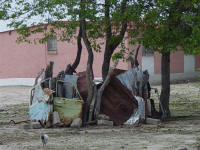
“Since I survived that year,” he always said, “I shall survive anything.” He put it down to his inflexible will. Omege I don’t even know where to begin. When I wrote last, it was from the Rural Development Center in Ongwediva. Everything was still normal and fine then. The group of volunteers we are with are just wonderful. I was having a good time – it felt like camp. Now everything has changed. I should explain. Learning about our host family So, on Thursday night, 4 days ago, we found out our host family site. They broke the 40 of us into groups ranging anywhere from 4-11 people each. Zac and I were assigned to Omege, along with 5 other people. Omege is a small village about 6 kilometers south of Oshakati. Oshakati is the largest town in the North, and is considered the capital of Owamboland, which is the region of the North that we are in. Along with our regional assignment, we received a sheet of paper describing the family and On Friday, they loaded us up according to which village we were going to- and then took us shopping. Most people bought the same things as us: sheets, pillows, laundry detergent, dish soap, lunch box (Tupperware), toilet paper, towels, snacks. All this cost us about N $ 300, which is about US$30. But we’re getting paid in Namibian dollars, so it hasn’t taken us long to quit converting. Right now we get N $ 50/day or $5 a day. They took us to the big shopping center in Oshakati, which would be like a strip mall in the US. The stores have really high security. You have to show them your receipt when you leave the store to prove you paid for the stuff you’re taking from the store. The security guards even frequently pat people down to make sure they are not hiding things in their clothes. They did not pat any of us down. Actually, we got to the stores at 8 am, but it didn’t open until 8:30 am. Then after we were done shopping, we sat around until 10:15am. People in our group complain about all the waiting. But I don’t mind. It is ridiculous to expect Namibia to function on American time. Things just happen when they happen. Forget about your watch. Moving to Omege Then they took us to our village. Everybody was pretty somber on the way there. I think we were all nervous because we didn’t know what to expect. They drove our van right into the schoolyard. All the kids gathered around us. We all felt a bit silly unloading our bulky bags. We fit the “rich American” stereotype all too well. We have still to learn how to live without “stuff”. Soon after we unloaded, a group of children, arranged in formation, began marching by and singing a song for us. I can’t remember all the words but it was something like this: “Our Peace Corps, Welcome, Welcome, We are happy you are here.” Something like that. I should remember every word since they sang it over and over about 20 times. It was the cutest thing ever. They must think I am the crazy white person because I kept crying. Zac keeps telling me to “be strong”, but things like that just get to me. It was a big deal that we came to the school. We sat in chairs under a tree (everything revolves around trees here because they provide shade) and all the school children gathered around. Then there was a speech by the principal, another one by the headman, then another song in their own language, then a speech by the Peace Corps thanking the village for hosting us. Now remember, we only stay here for abut 8 weeks during the rest of our training. So we will not stay here for the 2 years. After the ceremony, we met out host parents, or some representative of the family that could come to the ceremony. Our host mother was there, and I cannot even tell you how happy I was when she spoke English. After finishing a heated discussion on her cell phone, she took us to her house in the back of a truck,. That is the mode of transport here. People drive trucks around with a ton of people in the back. When we arrived at the house, I was so shocked. It is a brand new house and it could easily be a house in America. So I thought, well maybe everyone’s house is this nice on the inside and they just look bad from the outside. I had no idea how wrong that assumption was. So our new meme (pronounced May-May) made us a lunch of rice, potatoes and goat. Zac and I helped prepare the food because we don’t want anybody waiting on us, so it is best to help from the very beginning. A Tour of the Village After lunch, she went back to work. Zac and I hung around the house for a bit. We were meeting our 5 colleagues at 16:00 for a tour. Erasmus, the local liaison to the Peace Corps came and got us to take us to the school. We met the 2 other Peace Corps Trainers that live at our end of the village. One of the girls was complaining about having to walk to the school. So Erasmus was lucky to have a truck drive by & we climbed I the back and it took us to school. Now I understand why people from other countries think it is weird when Americans have such big vans and trucks with just 1 person in them. Here, you give rides to everybody you see walking in the same direction you are going. Of course. When we all met at the school, we discovered we were actually going to have a tour of the village, given by our I keep reminding myself that we are here at the dry time, and that it is not always this barren. It is the time before the little rains, so it has been dry since March. And even then they did not get much rain. All of Southern Africa is experiencing a drought. They say the food relief might come in a few months. Anyway, so we start walking to where Jacque, one of our fellow volunteers lives. We’re literally walking down a sand road in the middle of nowhere. So when we got to where Jacque lived, I began to discover the great inequalities of the world. She is staying in a traditional homestead. Here is a picture. (Sera drew a picture of vertical sticks, with an opening for a door, and a thatched pointed roof.) The compound is made up of many huts, divided by walls made of sticks. Some huts are made of cinder blocks. No kidding. Almost every compound has at least one real building. The huts are used as different rooms. Even when it is hot outside, it is still cool inside the huts because they are shaded. Some have cement floors but most just have sand. I wonder what happens when it rains? Jacque’s room is in the real building. It is a dark and dirty and small little room. The tin roof is the same as her ceiling. She seems ok with it, but it just seemed awful to me. While we were looking at the room, her meme & one of the sisters were rounding up chairs from who knows where for us to sit on. So we all sat there, outside the room in the sand, staring at each other. Then the meme started singing. I have no idea what the words meant. Then she went and found some book and had our translator write all of our names in it. She also wrote what we were wearing so the meme could remember who we were. After we sat there staring at each other a while longer, we said goodbye and left. Then we continued our trek across the desert to where Anand lives. Along the way, Anand was drinking a Mountain Dew. He asked Otilie, our trainer, what to do with the can. She took it from him and just tossed it onto the sand. We were all horrified, until she explained, “someone will pick it up. There is a refund.” And so, that explains why there is trash all over here. They figure someone else might want it or be able to use it. And they do. I am telling you the truth when I say I saw a pigpen made out of old rusty car doors. They’re very frugal here, but nothing ever looks nice. So, we finally get to Anand’s homestead after several false alarms “Is that your hut?” “No, I don’t think so…” We got there and about 10 kids ranging in age from 1-13? hung around staring at us as we inspected Anand’s room. His was similarly small, dark and dirty. On one wall there is a sheet covering what appears to be bird poop on the wall. We’re still not sure what it is. We have a strict policy here. Don’t think. Don’t think about home, don’t think about what’s in your food, don’t think about anything. Just get through it until the next day. Culture Shock That was my crucial mistake. I thought. We didn’t have the policy at that time. It was only our first day in Omege, and hadn’t learned how dangerous thinking was yet. So we finally get back to our own house, and all our family, plus several other miscellaneous people are there. I started helping to cut carrots for dinner. Then they brought in the big bowl of freshly slaughtered goat meat. That’s when things started to go terribly wrong. To make a very long story short, let it suffice to say that as the evening progressed, and as the smell of goat meat wafted through the house and penetrated every corner, I became progressively more and more sick. I had it coming out of both ends. Water wouldn’t even stay down. To make matters worse, I kept having visions of myself being all alone in the rooms that Anand & Jacque were staying in. I just couldn’t take it. I was hit with the full force of culture shock. I wasn’t prepared for seeing everything I saw that evening. I don’t know what could have prepared me for it. I see now that everything was escalated because I was sick, and that nothing was as bad as it seemed to me then. But I just kept thinking, how can the Peace Corps just leave us to fend for ourselves in this godforsaken country? But Saturday was another day. The sun came out and all was good. Well, not exactly. I still felt sick and I had no energy. So Zac went to training and I stayed home and slept. I was wholly convinced that I would never eat Namibian food again, especially not goat, and that I could survive for 2 years on just Gatorade and apples. So I spent Saturday napping and drinking fluids – including re-hydration salts, which are disgusting. The Peace Corps people were really worried and took me into see the Peace Corps medical officer. I just told her I was having a bit of culture shock combined with goat meat, and that nothing was really wrong. She understood completely. It’s ironic that Zac and I have it so easy compared to everyone else – and yet I’m the only one to get sick. I’m telling you, these volunteers are strong people. I don’t know how they make it here alone. On Sunday, I woke up feeling great and I was back to my normal self. I was even hungry enough to break my strict Gatorade and apple diet. We all piled in the back of a truck and sped down the road to the Catholic church. When we got there, everyone was standing around waiting. For what? I don’t know. Let me tell you about something else here that I don’t understand. Everybody is really poor. Most live in huts with no running water. We’re in a desert. And yet everybody dresses up all the time. There’s ladies decked out in their finest, riding to church down dusty, sandy roads in the back of pick up trucks. I just don’t understand any of it. And the shoes people wear! Considering everybody has to walk everywhere I would think they’d have practical shoes. But no, the same ridiculous shoes that girls in the US wear, they wear to traipse around in the sand. I don’t understand. If I just saw a picture of these people standing around waiting for church, I would have no idea they all lived in huts. I don’t know how they do it. Eventually, after some unseen signal, everybody poured into the church. They crammed onto benches. The church was packed. What was so astonishing was the ratio of adults to children. There were at least five kids for every adult. And they were all staring at us. Now, I didn’t understand any of the church service. It was foreign in so many ways – partly from the language, partly from it being a Catholic service, and partly because we’re in an entirely different culture. But the best part was towards the end when this miserable looking couple were called to the front of the church. They stood there looking extremely depressed, while 4 older women came out with what looked like big feather dusters and started waving them over the couple, while doing that shrill yelling that you’ve probably seen on TV. Meanwhile, everyone else was singing a song and thumping their hymn books. I had no idea what was going on. Turns out, the couple had recently gotten married and their marriage was being blessed. Who would have guessed? I thought someone had died. At the end of the service, everyone went out to the cemetery to visit their relative’s graves, and there was more singing. I think they did this because it was All Saints Day or something. Also, a woman came to tell us she got sick from potato peels. Zac, in a cross-cultural effort, made mashed potatoes for our host family and whoever else was around, and had left the peels on like normal. Turns out that’s really bad. Here, people will eat rancid goat meet but claim they get sick if they eat potato peels. Sunday afternoon, a truck came to take us to the RDC for another vaccination. I’ve had so many shots in my left shoulder that I don’t even feel them anymore. Zac is even beginning to get over his fear of needles. It was great getting back together with everyone to hear how their host families are. From what I could tell, Zac and I have the easiest placement out of everyone. I’m not sure how we got so lucky. But I’m really hoping this doesn’t mean we’ll have the worst placement for our two-year assignment. I sort of feel that Zac and I aren’t having the true host family experience. Everyone else is eating horrible food, hovering on the brink of starvation, learning to communicate in the local language, and making friends with their host siblings. Although Zac and I aren’t exactly eating as good as we were in the states, we’re not starving because we can usually cook for ourselves. Our host family speaks English, and our siblings run around scared of us. Although the nine year old did say “Good Morning” to me today, even though it was 6 pm. Well, this letter is already too long, so I’ll wind it down now. Just know that we’re doing fine. Love, Sera click here for more pictures of Omege and our host family
|

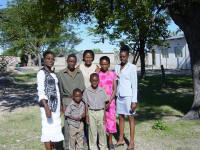 house we were to move into. Most people’s families had 10-14 children. Ours had 2 kids. Most people were lucky to have a latrine with a roof on it – we had a “modern toilet”. Even on paper it appeared we had an easy assignment. I had no idea just how easy.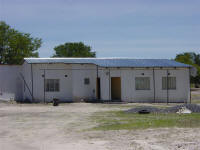
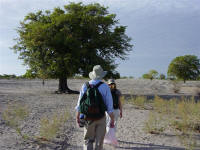 trainer, Otilie, & Erasmus. I was lucky to have brought water and be wearing comfortable sandals. We just started walking. Now, remember, we’re in a desert here. There is no shade and we’re walking in sand. I am scared of the desert because it just seems like you will dry up and die there. I don’t know how the few trees even survive. I don’t know how I’m going to survive here for 2 years. I love water.