|
A Wet Weekend at Ruacana Falls
Hello Everyone, I hope you all had a happy Independence Day last weekend. That’s right; Namibia hit the big one-four on the 21st of March. I didn’t see too much fanfare but I did take advantage of the four-day weekend with a trip up to Ruacana Falls, which is up on the border with Angola. I bolted to Ondangwa on Thursday after school and met up with some other volunteers. After some dinner we left for Tsandi where another volunteer has a site; the next morning we left early for Ruacana. Our plan was to make it to a campground and then go and see the falls. We were very lucky to get a taxi in Tsandi that took us all the way to our campsite. The site was really cool; it had a giant tree right in the middle of it and was on the bank of the Kunene River. Just to provide some perspective on this volunteer stuff, the campsite was equipped with showers and toilet facilities, which makes the amenities at this campground better than those at most of the volunteers sites (the ones that don’t live in government housing).
The next day was the day that we had been planning to see some Himba people. The Himba are a tribe of Namibia that has avoided westernization. Most apparent, and unlike the Owambo, their dress is completely traditional. Because of their dress (or lack there of) they are very “African” and are sought after to be subjects in photos. They want money for taking a picture of them and to tour a village you need to bring “gifts” including a load of sugar and meal, and money for tobacco. We had met a guide at the campsite who was going to give us a tour of a nearby village but when we found out that he had gone home for the weekend that plan fell through. We had seen some of the Himba at a nearby cuca shop but if we wanted to tour a proper village we would have to hitchhike all the way to Opuwo. Our group split up at this point because some people wanted to go to Opuwo and some people wanted to stay at the campsite, which is what I chose to do. The idea of going to goggle at people and pay to take their picture wasn’t overly appealing to me. (I know how it feels to be gawked at!) Additionally, Opuwo is in the middle of nowhere and there was the possibility that it would be difficult to make it back to Ekulo on Monday. Besides, I didn’t want to pass up the opportunity to jump off of a cliff! Yes indeed, we had heard rumors of a secret pool somewhere down the road where, if one was so inclined, one could do some cliff jumping. We left, inevitably, at noon and it took us a good three hours to walk 10k down the road and then find the place. It was way out in the bush and we almost didn’t find it. While we were wandering around we saw a troop of monkeys, which I thought was really cool. They were small and kept their distance from us but it was amazing to see how swiftly they could cross the rugged landscape. With the wild animals and the exotic terrain it felt like I was inside a zoo exhibit. We eventually found the spot and (after checking the depth) we took the plunge. There was a small cliff about the height of a high dive, which we did first and then we graduated to the big one. The only other time I have attempted this sort of thing was when I was in fifth grade and was with my family was on the Spanish island of Minorca. I went up to the jumping spot with my Dad and then I chickened out. As I stood on Saturday looking down at the water forty or so feet below I rediscovered that fear. It’s a long way down! I jumped anyway and the only thing bad that happened was that my feet hurt from hitting the water. Also, my watch was almost lost on the second jump as the water caught the Velcro band and undid it. After we had our fill of the pool we decided to take a “shortcut” back to the road. After wandering through the bush in the rain semi-lost some more we made it back to the road and then back to the campsite. The whole trip took seven hours; we had had plenty of water but not enough food so we were pretty hungry. It felt great to get some good exercise. The next day we let some VSO volunteers borrow one of our pots (they had three coolers but no pot?) in exchange for a lift to the nearest cuca shop where we could get a lift back to town. When we made it back to town we all had lunch at Nandos (Portuguese fast food chicken) and then spent the night at another volunteer’s site. I returned home on Monday morning. Over the whole trip I was in at least fourteen different lifts of various kinds and spent about 500 Namibian dollars. I crossed the checkpoint to leave Namibia but I was disappointed that I never made it to Angola proper, although I could have thrown a rock into it. Well that about sums up my holiday weekend. I hope the weather is warming up for everyone. The rains here have slowly tapered off. The legions of flies are dwindling and the SUV crickets are wreaking havoc on the mahangu. Those 11 eggs still haven’t hatched yet. The hen is still sitting on them but I am beginning to wonder if they are viable. Have a good weekend. click here for more photos of Raucana Falls
|

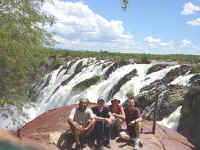 Around noon (D’oh) we set off for the falls on foot and in less than two hours we were there (we walked along a nice but hilly road). At the falls we were greeted with an impressive sight. They weren’t as big as Niagara Falls, but then again, the fact that there was absolutely none of the development that accompanies every tourist trap in the States (and Canada in this case) did lend it some exotic third-world charm. We had the lookout spot all to ourselves and after taking lots of photos we went down to the bottom of the falls. After searching for and finding the way down (see, lots of charm: no guide signs) we started descending the 400 or so narrow stairs to the bottom. The air quickly became humid and then drenched as we entered the spray zone. Adding to the wetness was the leaky four-foot pipe full of rushing water that ran adjacent to the stairs. The stairs were wet and muddy but, to be fair, there was a dilapidated and slimy handrail to help (so much charm that it’s a health hazard!) The view at the bottom was wonderful and the misty water droplets in the air were refreshing (although we were all hoping our cameras would come out alive). Anyway, the giant pipe full of water ended up running into a small derelict building that used to have something to do with hydroelectric power. While most of the group decided to go back to the campsite via the stairs and the road, I, Seth and Robby decided to demonstrate why, exactly, this place would be closed in a heartbeat if it were on US soil. We walked through the derelict building full of water, over the walkway, down the ladder and across the chasm to the get to the rocky shore so we could walk back to the campsite along the river. The hike along the river was a lot of fun and, although we didn’t really know it before hand, quite a bit shorter that the route along the road. We didn’t see any snakes or crocodiles; the only tricky part involved a really hot boulder and its proximity to the water.