|
Peru: Cusco & Sacred Valley
July 28-30, 2009

|
|
Altitude
We arrived in Cusco around noon. In 23 hours, we’d gone from sea level to over 11,000 feet. We felt ok—no signs of altitude sickness–except Zac was a little headachy. But 23 hours on a bus can do that to you, so it wasn’t necessarily from the altitude. Outside the bus station, we got in a taxi with a friendly driver who pointed out famous landmarks on the way to our hostel. We had to walk up a steep hill to reach our hostel and it was then that we felt the effects of the altitude. Every few steps we were out of breath. We had reserved a private room with a bathroom at our hostel, knowing we would want to be able to relax and shower after enduring such a grueling bus ride. But alas, our room was not yet ready, so we just left our bags near the desk, and headed out in search of lunch.
I usually don’t follow the Lonely Planet recommendations for restaurants, but we were so tired we didn’t feel like searching. We hadn’t had a real meal since the toasted ham and cheese sandwiches the morning before. We located a restaurant near our hostel. It was in the tourist district, so the menu was in English. In Peru, most restaurants had set menu, with some choices, that was inexplicably cheaper than ordering a la carte off the menu. For the most part, Zac and I always ate the set menus, which often included a drink, appetizer and main dish. The drink (unless it was coffee or tea) was always served at room temperature without ice. At this restaurant, Zac ordered an alpalca fillet, and I got chicken and potatoes. The potatoes were cooked, then chilled, the covered with yellow goop (allegedly something cheese related). It turned out to be a common side dish called papa a la huancaina. I didn’t care for it.
Our main goal for the afternoon was to figure out how to get to Machu Picchu, for which Cusco was a launching point. It’s actually a little more complicated than it should be. To get to Aguas Calientes, the tourist town right below Machu Picchu, one can only take a train. Peru Rail has a monopoly on this train, and therefore charges exorbitant prices. One can take the train from nearby Cusco all the way to Aguas Calientes, or take a bus to Ollantaytambo, a town closer to Aguas Calientes, where the train fare is a bit cheaper. Once in Aguas Calientes, one must take a shuttle bus up to Machu Picchu. Unlike Pedro at our former hostel, our new hostel owners gave no indication of helping us arrange our onward journey. We were having trouble reserving our tickets on the Peru Rail website, when we started talking to a European couple that was staying at out hostel. They had just signed up for a tour with Inka Time, an agency that arranged all the parts of the trip, plus a day tour of the Sacred Valley. They told us what they paid, and it seemed cheaper to combine all the parts of the trip with a tour agency, then to try and do the legs on our own.
Eddy
In this innocuous way, our ill-fated relationship with Eddy began (yes, eddy, as in going around in circles). We met him at the tour agency that the couple recommended. I had my trip calendar out, and we explained what we wanted. He gave us the tour spiel, and seemed annoyed when I kept interrupting to clarify parts. Eventually we found an agreeable itinerary: We would spend tomorrow taking the day tour of the Sacred Valley. The next day, a bus would pick us up at our hostel and take us to Ollantaytambo, where we would take a train to Aguas Calientes. We would have the afternoon to wander around that town. Then the next morning we would take the bus up to Machu Picchu, and spend the whole day there. Around 5 pm we’d take the train back to Ollantaytambo, where a bus would meet us and transport us back to Cusco. It seemed like a good plan.
The part where it all went terribly wrong was when Eddy accidentally got the return train ticket for 5am instead of 5pm. Peru Rail, which we came in time to dub Poopoo Rail, required that Eddy and Zac go stand in line at the main office in order to change the ticket. Eddy would get there at five to get a place in line, and Zac would get picked up by Eddy’s friend around 6am to go meet Eddy. It would be annoying—we had wanted to spend the morning exploring Cusco a little, or at least sleeping in–but it was an innocent mistake and Eddy was very apologetic. So we tried not to harbor any hard feelings. I was exhausted and irritable, having not slept well on the bus, so not harboring hard feelings at this inconvenience took a lot of effort.
|
View of Cusco on the bus ride in
Plaza de Armas
View of Cusco from our hostel
Our hostel
Common room in the hostel
Our first room at the hostel
|
|
|
Fountain in Plaza de Armas |
Chicha morada (purple corn drink) and pisco sour |
Typical meal: meat, rice, cold vegetables, fried potatoes |
Night view of Cusco from our hostel |
|
Mazamorra morada
The redeeming moment of the night was when we discovered a lot of people eating something out of bowls from a street vendor in San Blas Plaza, near our hostel. I bought one, and it turned out to be a warm custard of the purple corn drink mixed with rice pudding. It was delicious. We returned to our hostel and drank the complimentary coca tea. In Cusco, as with most places on our trip, the nights were cold. It’s winter in Peru, but it’s near the equator, so Lima, for example, was not very cold—mid 60’s. However, in Cusco, due to its higher altitude, it got down to below 40 at night, and the hostel had no heat. No houses have heat either. The only way to stay warm was lots of layers and lots of tea.
The next morning Zac rose early to go fix the train ticket mess, while I packed up our bags, which appeared to have exploded all over the room. Due to a reservation snafu, we had to move to another room for the next night. They got the ticket changed, which cost us an additional $40 (starting to harbor hard feelings…) and then we were off for our tour of the Sacred Valley.
|
San Blas Plaza
Drinking tea to stay warm
|
|
|
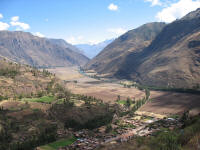
The Sacred Valley |
|
The Sacred Valley
Our guide was Angelo. He spoke Spanish very slowly, and his English wasn’t very good. He would say a lot in Spanish, and then just a couple of sentences in English. Our first stop was a tourist trap: vendors selling their woven goods. Not appreciating being captively brought to such a market, we didn’t buy anything.
|
Tourist trap |
|
|
|
|
Pisac
The next stop was Pisac, where we viewed Incan ruins. Angelo told us only the important people would live in these cities in the mountains—the political and religious people. He also told us how the Inca worshipped the sun, and that’s why they built their sacred cities on mountains—to be closer to the sun. They were also obsessed with terraces.
|
|
|
|
|
|
|
|
|
Ollantaytambo
Our next stop was lunch in Urumbamba. Our tour included a buffet lunch, and both Eddy and Angelo pronounced the “t”. I tried lots of different food that I couldn’t identify. The food began to cause me great pain and suffering, which lasted the rest of the day. Luckily, this was the only time I really got sick from the food the whole trip.
The Incan ruins at Ollantaytambo were our next destination. More walls, more terraces, more temples. Really, considering the Incan empire only lasted about a hundred years, it’s absurd the amount of rocks they arranged.
|
|
|
|
|
|
Chinchero
Our final stop was a colonial church in Chinchero, built on Inca foundations. My guidebook tells me there was also a massive ancient Inca wall in Chinchero, but we didn’t see it, presumably because it was too dark by this point. While I spent some quality time in the bathroom, Zac bought some alpalca street meat. For the rest of the trip, whenever he ate alpalca, he would always comment that it wasn’t as good as what he bought on the street in Chinchero.
|
|
|
|
|
|
Cusco
On the tour bus, I made friends with the young Peruvian woman sitting across the aisle from me. Her English was really good, so we were capable of having a conversation. Maria lived in Lima and worked for a restaurant as a caterer. She had also worked at Disney World for a summer. She and her friend were traveling around, since they had some time off work for the national holiday. She was slated to go to Machu Picchu the same day as us, so at the end of the tour, I joked, “See you at Machu Picchu Friday!”
The tour bus dropped us off at the Plaza de Armas, and we headed back up to our hostel, via the tourist district. Cusco was the Incan capital during their brief reign, and one of the cobblestoned streets was flanked by an Incan wall, incorporated into the side of the modern buildings. The streets in the historical part of Cusco were very narrow—designed for horses perhaps, but definitely not taxis. Most streets were so narrow they had to be one way. The sidewalk was only wide enough for one person, so most people walked in the steep streets and just squeezed onto the sidewalk when a car passed.
We were in a dorm room at the same hostel that night. Our roommate, Tracy, was from Minnesota where she lived in her car. She was a fine arts major, something about poetry, but she claimed she had worked in corporate, hated it, cashed out her retirement, and figured she could afford to live in her car for a couple of years. She was in Peru to hike the Inca Trail to Machu Picchu with a friend. I suggested she join the Peace Corps.
On Thursday morning, we packed up our large bag to leave at the hostel, and just took the smaller backback for our one-night stay in Aguas Calientes. Eddy came and collected us at our hostel, and took us to a taxi. I thought we’d be on a tour bus, but for some reason it was just us, the taxi driver, and Eddy. The hour long ride to Ollantaytambo was beautiful. We could see snow-capped mountains in the distance, which endlessly thrilled us. Eddy said we’d be getting a bus ticket up and down to Machu Picchu, to make amends for the train ticket fiasco. I also asked him about a bus ticket to Puno, our next destination, and he said he could get that for us. In a show of good faith, we gave him the cash to buy the ticket, so he could have it for us when we got back from Machu Picchu.
|
Incan wall
Narrow streets of Cusco
|
|
|
|
|
When we arrived at Ollantaytambo, Eddy went into the train station to check us in. He was in there a really long time. When he came out, he revealed that there was a problem. The revised ticket, although for the right time, turned out to be for the wrong date. It had us going back on the same day. (Peru Rail was being inflexible and wouldn’t change it.) I couldn’t believe it. I mean, you’d think after the first mistake, Eddy would have checked everything very carefully. Isn’t that why he gets a commission? The theory is that we’re paying a little extra because he is supposed to do a better job at arranging things than us. He kept saying, “Don’t worry, don’t worry, I’ll fix it.” So we proceeded to take the train the Aguas Calientes; he would take the next train and we’d meet at our hotel around 12:30. He seemed to think he could change the ticket at the train station there.
|
|
|
|
|
   |
|