|
CHINESE SLIPPERS
My favorite class by far is my A7 adult class that I teach for two hours every Monday, Wednesday, and Friday. Because the students are at a pretty high level, the focus of the class is on conversation, with a few grammar tips or vocabulary words thrown in for good measure. The book for the class is arranged topically and the guidelines indicate that I should do two of the topics per class. I take that with a grain of salt, spending more time on the interesting topics and less time on the boring ones, depending on how much the students talk. For example, they whipped right through the “appearances” and “gender roles” topics, but spent a surprising amount of time on “business,” which I thought would be really boring. In small groups, I had them come up with a business plan and present it to the class for approval. The class got really into it, asking questions like This class is really perfect for me, because I learn a lot about Chinese culture and customs from the class, particularly during the topic, “Cultural Differences.” For this, I divided them into small groups and gave each group a topic such as eating in a restaurant, going to a friend’s house for dinner, a first date, celebrating a birthday, etc. and they had to tell me their customs for each occasion, then I told them the western custom. I learned that in restaurants here, the tea is free. I didn’t realize this before because I could never decipher the bill. It is also the custom for one person to pay for everything, as a way of showing how rich he is. And since everyone shares the dishes, it is polite to eat a little bit of everything, and not just eat your favorite dish. Celebrating birthdays is about the same as in the U.S., with a birthday cake, candles and gifts, except that here they apparently like to smear frosting on each other. One quirk is that here is the way they count age here. A perfect example of this is that one of the girls in my class was born in 1980, the same year as me. I asked her how old she was, and she said 26. I said, “I’m 24.” And we all had a good laugh over that. In China, when you are born, you are already 1 year old, since they count the gestation period (I find this a bit ironic in a country with a high abortion rate, since it implies they consider you a person from the time you are conceived). Furthermore, your age is determined by the year that you are born, not so much the exact day. For example, right now I say I am 24 until I turn 25 in April. But in China, I would say I am 25 from January 1st, 2005 since this year is my 25th year. Although, if I were really doing it the Chinese way, I would be 26 this year, since I was already one when I was born. On woman in the class was born on December 30th, so she was one year old on that day. Then, on January 1st, she was two years old, even although she was really only 3 days old. They told me that nowadays, they use both this traditional way of counting age, as well as the western way. For example there is a married couple in my class who have an 8-month old baby. Another way of saying your age is just to say which year you were born in according to the traditional calendar. So I was born in the year of the monkey and Zac was born in the year of the horse (they told me the monkey and horse is a good match). When a kid turns 12, that is an important birthday because the traditional calendar goes in twelve year cycles. This is the year of the rooster, so for everyone who was born twelve years ago in the year of the rooster, this is special. 60 is also an important age because it is five twelve-year cycles. The unlucky ages are 73 and 84 because that’s when people die in China (they swear it’s true). Those are the traditional death ages because Confucius died when he was 73 and Chairman Mao died at 84. When someone invites you to dinner, you are supposed to say no a few times, and if they are really serious, they will keep insisting you come. But I didn’t know this the night before. A bunch of us foreign teachers from all the different Future English schools in Dalian got together at a bar to celebrate St. Patrick’s day. One of the teachers is actually from Ireland, so although we were in China, it was probably the most authentic St. Patrick’s Day I’ve ever had. Plus, the beer here comes in green bottles. (I tried to fit in by drinking sprite, but it came in a can, not a bottle. Foiled again.) One of the foreign teachers has a Chinese girlfriend, who doesn’t speak much English, but I tried talking to her anyway. After a while, she invited me to come over for dinner sometime. I said OK. She kept insisting that I come. I kept saying OK. I thought that was strange because I had already agreed to come, but apparently she was used to having to insist again and again, so she continued to do this, even although I had broken the etiquette and agreed after only the first invitation. I’ll know what to do for next time though. My class also told me that when you go to someone’s house, you can bring a small gift like fruit or flowers. You should arrive on time. (Yes! No more of the Namibian 7pm means 8pm nonsense!) When you come in the door, you should take off your shoes and put on slippers. “Wait,” I said. “You have to bring slippers with you?” No, they provide you with slippers. “What if a lot of people come? If you have a party?” We have a lot of slippers, or we can buy more. They are cheap. We even have winter slippers and summer slippers. And sometimes we have bathroom slippers and kitchen slippers. “Wow, your houses must be full of slippers.” Yes, but our floors are clean. And sometimes we can put plastic bags over our shoes to walk in the house. Sure enough, when we went over to Frank’s girlfriend’s house for dinner on Sunday after work, we took off our shoes and she brought us slippers to put on. Frank and Jojenn are an interesting story. They met in Afghanistan where Frank, who is 46, had a year contract helping them set up a telecommunications system. Jojenn, who is originally from China, had a clothing shop there. Frank didn’t want to renew his contract, so he gave Jojenn money to come back to China and find them an apartment. He went back to the U.S. for a bit, got a visa for China, and came here to live with Jojenn and her 19-year old daughter. He found a job at the Future school, and is now going to be our manager. He was really skinny in Afghanistan, because he was sick for the entire year, but now he is getting fat because Jojenn is an excellent cook. She tried to teach me to cook, but it was a bit difficult because her English isn’t good (she didn’t know any before she met Frank) and she couldn’t explain the ingredients she had put in. When we got there, it was like arriving at a cooking show, where everything is already nicely prepared so it looks really easy to cook, although you know they spent a long time putting everything together. She already had the pork filling all made, but she taught me how to put it on the dumplings and fold them properly. I so impressed her with my dumpling folding skills that she couldn’t believe I had never made dumplings before. She also made egg rolls, stir-fry, a bean-sprout dish, and eggplant stuffed with pork filling and deep fried. She cooked everything using chopsticks. It was really good. In my class, they told me that when you go to eat dinner at someone’s house, you should prepare an interesting topic to talk about. Well, the five of us were quite an interesting group. Zac and I have only had three Chinese lessons so far, so we only know how to say things like, “I’d like some rice” and “I don’t like spicy food.” Jojenn speaks little English, mostly words strung haphazardly together. Frank can speak a few words of Chinese, but he butchers the pronunciation. He talks quite a bit around us, and I bet it’s because he can’t really talk to his girlfriend. Jojenn’s daughter doesn’t speak any English, although I think she understands it a bit. So the dinner conversation was a lot like charades. Despite the language barrier, I have found Chinese people extremely easy to get along with. I have experienced none of the culture shock and social unease that I felt in Namibia. I’m sure a major reason is that we are living in a modern city and not in a village. Furthermore, the poverty is not so great in our city and most of the people we meet tend to be educated. We have not been asked for sweets by any children nor money by any drunk people. People might look at us a bit longer, but they don’t stare. When we walk up and down our street, we don’t get harassed by the vendors, and I’ve only heard an occasional taunting “hello!” shouted by teenagers. The sweet potato man and fruit woman don’t try to rip us off. It is very easy to be here.
|

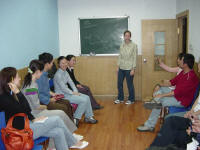 , “Do you really think Y50,000 will be enough money to start the business?” and “No one will visit your travel bookshop—they will just use the internet” and “Your coffee shop can only hold about 20 customers, are you sure you will make money?” The whole class turned out to be a bunch of capitalists.