|
Peru: Lima
July 26-27, 2009

|
|
Airport Taxis
We only had a few hours of sleep on the plane because the flight attendants kept waking us to feed us and make us fill out immigration forms. It was in this tired state that we had to face the first nuisance of foreign travel: airport taxis. Most taxi drivers are known to try and rip off tourists, but taxis at the airport are the worst. We tourists are obviously naive in our first few minutes in a foreign country, we are unfamiliar with the different currency and its value, we are groggy from the flight, we just want to get to our hostel…all these vulnerabilities are exploited by the taxi drivers that hover outside the airport terminal. In Peru, taxis are never metered, so the price is negotiated first. We showed a taxi driver our hostel address, he said he knew how to get there, and we agreed on fifteen dollars, which I felt was fair, since the hostel charged $17 for an airport pick up. In the early morning darkness, we rode through the just-awakening streets of Lima. The city had a dismal, industrial feel—gray concrete seemed to be a popular building material.
In time, it became clear that our driver had misled us in two important ways: #1. He did not actually know how to get to our hostel, so I, the foreigner, had to help navigate using a Google map I had printed out at home. #2. The price for the ride was actually 20 dollars. This was a very clever trick. As he filled out the official receipt, he revealed that there was a $5 airport tax. While it’s possible that this is true, that taxis have to pay some sort of surcharge to go inside the airport gates for the privilege of preying on vulnerable tourists (as described above)—it was the deception that irked me. If he had said from the beginning it cost twenty bucks, I wouldn’t have minded. What is an extra five dollars in the grand scheme of things? But it’s the principle of the matter.
Backpacker’s Family House
Our hostel located, our deceptively increased taxi fare paid, we found ourselves standing with our two large backpacks, and our two small backpacks outside a brown, unmarked door. Our guidebook, the Lonely Planet, had forewarned such an oddity: “Be aware that hostels in Lima face a lot of expensive red tape to put up a sign on the front of their establishment, so many of the budget options have no sign and can look for all the world like ordinary houses from the outside.” Upon closer inspection, we discovered “Backpackers Family House” lightly stenciled above the street number. We rang the bell. Nothing happened. We rang again. A somnambulant man opened the door, led us inside, checked his register for our reservation, indicated that the two sofas in the common area were ours for the next couple of hours, then collapsed back on his own couch. We gladly napped for an hour or two.
At a more respectable hour, we woke, washed our faces, brushed our teeth, and prepared to present ourselves to the vast city of Lima. Pedro, the hostel owner, gave us a local map and indicated where we could find an ATM and a grocery store with a restaurant on top for breakfast. He said he’d call around to get us bus tickets to Cusco, and we should call him back in two hours. Thus armed, we headed out. We were staying in Miraflores, a wealthy and safe suburb of Lima. We found the main road and walked down the tree-lined walkway in the middle of the boulevard. The weather in Lima left a lot to be desired. Clouds hung over the city like a pall and it occasionally drizzled or misted. Later, we found out the coast was shrouded in clouds the whole winter.
Miraflores
We located the grocery store—it was beautiful—the Peruvian equivalent of Fresh Market or maybe Whole Foods without the organic emphasis. Zac and I are perhaps a bit odd in that in our travels, we love to visit grocery stores. Maybe it is because it is one of the few insights we can get into what life must be like in the country for a normal person living there. Perhaps it is because we spent so much time scouring supermarket shelves in Namibia and China, looking for new meal ideas or recognizable ingredients. At this upscale, well-stocked Peruvian grocery store, we decided we could definitely live here. The rooftop restaurant looked too expensive, so for breakfast, we bought some bread, a yogurt drink, something like a slim jim, water, and a bottle of chicha morada—a traditional drink made by boiling purple corn along with pineapple, some lemon and whatever else one feels like adding. It sounds gross–the whole purple corn part–but it was a delicious drink that that I imbibed throughout the rest of the trip.
Museo de la Nacion
After we ate breakfast, we took a taxi to the Museo de la Nacion, a gargantuan concrete structure where we hoped to learn about the history of Peru. Instead, we learned that they dug up a bunch of Incan artifacts, they painted a plethora of religious art, and they invented the potato. There was a whole room devoted to the different types of potatoes, and even a case displaying various bags of potato chips. Most of the placards were in Spanish only, so the museum would have been more edifying if we were more literate. Outside the museum, we found a pay phone and placed a call to Pedro, who said he had yet to locate a bus ticket for us, what with the national holiday this week and all. He was still working on it.
|
Zac outside the hostel
Sera in the dorm room
Miraflores
Museo de la Nacion
|
|
|
|
|
|
Plaza de Armas
Click here to watch video
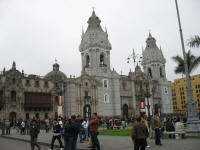
Lima is a giant, sprawling city. It is impossible to walk from one tourist attraction to another. So we hailed a cab and headed off to the center of town, the Plaza de Armas. The Plaza de Armas is the center of every town in Peru: it is the proverbial the town square, surrounded usually by cathedrals and other impressive buildings, with a fountain in the center. From a tourist perspective, they make a very convenient central location to ask taxi drivers to let you off. This Plaza de Armas, in central Lima, was very impressive. It was also filled with people. The taxi driver had warned us that there was a fiesta going on there because of the Independence Day celebration, called Fiestas Patrias. The official days were July 28 and 29—still two days away. There was a band playing on a stage, and swarms of people. Some people carrying flags on horseback rode by.
We wandered around and eventually found a giant pedestrian street. We were feeling very authentic, as to our untrained eyes, we couldn’t discern any other foreigners among the Peruvians. We found a restaurant with a poster of plates of chicken and fries and decided to eat there. I tried to order to the plate I saw on the poster, but the waiter was having none of it, and directed me to a dish on the menu that cost twice as much. My Spanish is pretty limited, and so I’ll give him the benefit of the doubt and blame myself: I must not have been communicating what I wanted properly, and that’s why he said they didn’t have any, then proceeded to serve every other patron in the restaurant the dish I wanted. Anyway, I ended up with chicken and green rice, and Zac ended up with chicken soup. We ordered Inca Kola and tea to drink. Inca Kola is a distinctive Peruvian soda that is bright yellow and very sweet. The Lonely Planet says it tastes like bubblegum.
We walked around a bit more, looking at shops and people, and then called Pedro again. He had found us a ticket at a bus company, Cial, but he didn’t tell us how to get there. For some reason, we got it in our heads that it was close to where we were, so we started asking around. We’d go up to a woman in a shop, and in my caveman-Spanish, I’d say something like, “Do you know where Cial is? Bus. Can I walk?” Except I couldn’t remember the word for walk, so I would mime that with my fingers. I also couldn’t remember the word for “close” which would have been very helpful. My inquiries where met with an onslaught of Spanish that I couldn’t decipher, so we’d just walk a couple of blocks in the direction the woman gestured, then repeat the questions with another shopkeeper. After we walked for probably an half an hour following the directions of arms and fingers, venturing into more and more derelict parts of Lima, we gave up and got in a taxi. He drove for probably 10 minutes, miles really, until we reached Cial. Zac and I were incredulous. Why had all those women indicated that we could walk here? We never would have found it, even if we walked all night. My guess is that they didn’t understand what we were asking, or they were directing us to the place where we could get a bus to get to the long-distance bus station.
Finally at the bus station, we successfully purchased a ticket to Cusco from a very nice woman who spoke some English, while I spoke some Spanish. The bus ride would be 20 hours long, she said, and our seats were on the first floor of the bus, first class, since all the cheaper seats upstairs were full. We were to report to the bus station the next day at 1:15pm.
|
|
 |
|
|
|
Miraflores
We took a taxi back to our hostel, where we were finally able to check into our dorm room. We then headed back out on foot, to wander the main drag in Miraflores. We were still full from lunch, so we decided to forgo an official supper and dine on street food instead. Plus, maybe, I was still mad about not getting what I wanted for lunch. We had some fritters and ice cream. Very healthy.
The next morning at our hostel we ate some pop tarts we’d brought from home and drank water for breakfast. We headed out to spend our morning walking along the coast. Clouds still covered the sky, giving an already dreary ocean front no help. The beach was rocky, and flanked on the eastern side by high cliffs, on top of which perched the successful businesses and wealthy condos of the Miraflores district. Right near our hostel there was a lovely park, with steps leading down to the beach. We walked on the lower part, by the beach, and watched surfers try to get up on the puny waves, until we finally came to a road heading up again. Although the beach itself seemed neglected, the part above the cliffs was verdant with carefully landscaped parks. We had a second breakfast at a restaurant called Havanna, with glass windows overlooking the coast. We ordered the set breakfast, which consisted of a toasted ham and cheese sandwich, espresso, freshly squeezed orange juice and a rich chocolate cookie. Buzzing with caffeine and sugar, we walked back to the neighborhood of our hostel and stocked up on water, chicha morada, two oranges and five little bananas for our bus ride.
|
|
|
|
|
|
|
|
|
23 hours on a bus
We took a taxi to the Cial bus station, arriving a half an hour early as directed. Our bus was then nearly an hour late. Our seats on the bus were big and comfortable, and we had a great view of the TV which proceeded to show us six and a half movies over the course of the 23 hour bus ride (it turned off for a while so we could sleep during the night). They were all American movies, dubbed in Spanish, with English subtitles. We watch a lot of foreign films, so subtitles are nothing new to us, but watching Nicolas Cage or Liam Neeson appear to speak Spanish was a novelty. Watching so many movies in a row, I began to pick out common themes. The main one seemed to be the estranged father trying to make nice with his offspring, while the step-father (or similar figure) always upstages him. (Taken, Night at the Museum, The Game Plan, Madagascar II). Another theme seemed to be that knowing the future doesn’t mean that future will come true; in fact, knowing the future is a pretty big indicator that you will change the future (Next, Push). The final, minor theme was that pirated DVD’s sometimes fail halfway through (Pink Panther).
Time passed quickly with all the movies. Paradoxically, the only hard part of the trip was that the bus had a bathroom. Since there was a bathroom on the bus, it never stopped to let us off to stretch our legs, breath fresh air, buy some food, or use a non-mobile toilet. The toilet on the bus was ok in the beginning, just a little wet. As time went on, it got perpetually grosser. The wetness covered the floor and sloshed around. In Peru, one is not supposed to flush toilet paper. On the bus, one is supposed to urinate only. Evidently a few people on the bus were not adhering to those rules, to the detriment of all of us. The toilet became clogged, and full, and the bus was moving. I didn’t eat or drink anything for the second half of the trip, hoping to minimize my need to use the toilet.
Our only reprieve, the only time we got off the bus, was when, about two hours from Cusco, our bus sustained a flat tire. We could finally get out and mill around while they fixed it. The air up in the small Andean town was crisp and cold. The sky was an impossible bright blue.
In Ica, one of the major towns early in the trip where we stopped to pick up more passengers, we were joined in our small first class section by an Ica native named Oscar. Oscar had long graying hair and was possibly the Peruvian version of a former hippie or beatnik. Oscar was friendly and he revealed that he was a musician who now lives in Cusco. He had even lived in Germany for a while. He advised us to drink lots of coca tea in Cusco to help with the altitude. Coca tea is made with leaves from the Coca tree, which somebody told us is only legally grown in Peru and Bolivia. Coca tea allegedly helps with everything.
|
Flowers in Miraflores
Our bus
|
| Views on the bus ride from Lima to Cusco |
|
|
|
|
|
|
|
|
|
  |
|
