|
Peru: Machu Picchu
July 30-31, 2009

|
|
Aguas Calientes (Machu Picchu Town)
Our expensive train ride to Aguas Calientes was only about one and half hours long. The train descended from the cool altitude of Ollantaytambo into the jungle-like cloud forest. The three-thousand foot drop in elevation was evident in the warmth and the vegetation. Scrubby mountain plants were replaced by vines and palms and moss. Aguas Calientes itself is a town that exists solely for the purpose of tourists who visit Machu Picchu. The train tracks literally go through the center of the small town, which itself was unsightly, consisting primarily of restaurants, hotels and souvenir shops with little regard to aesthetically pleasing architecture. But it was redeemed by its environment: high mountain walls and a beautiful mountain river flanked the town.
We had lunch in a restaurant that we chose because it had large glass windows overlooking the river. There was only one woman working in the entire restaurant, and at one point she had to leave to get eggs for Zac’s ham and cheese and egg sandwich, which he said wasn’t very good since the “ham” was more like bologna. I ordered the “Special Pancake” which turned out to be quite good: a crepe-like pancake folded over pieces of fruit and dotted with candied cherries.
As we were leaving the restaurant, Eddy met us on the street. We followed him to the train station, where we waited in line to try and get the ticket changed. When we finally got to the window, Eddy spoke with the agent. The Spanish was fast, and I couldn’t follow the negotiations, but I could tell it wasn’t going well. When the conversation was over, Eddy led us aside and explained that the agent was refusing to change the ticket. This, even although two girls in line behind us were desperate for a train ticket out of there that afternoon and were willing to buy our seats. The inflexibility of Poopoo Rail was inconsistent with everything else in the country. Had it been a bus or a taxi or a tour, Eddy would have fared better. People are willing to make accommodations. But Poopoo Rail was a corporation with a monopoly, and that entitled them to be completely uncooperative. Eddy even spoke with the manager, to no avail. He made calls on his cell phone and assured us he’d get this worked out. He said to meet again at our hostel, around 4.
To Eddy’s credit, he was taking responsibility for his mistakes and not just abandoning us. But when you’ve only got 13 days in Peru, and only 8 or 9 hours in Aguas Calientes, it is annoying to be burdened and limited by having to keep meeting up. For example, we wanted to go to the Machu Picchu museum, and then do a little hiking, but now we only had a couple of hours before we had to come back and meet. I was definitely harboring hard feelings at this point. Also, if we had our tickets to Machu Picchu, we could get into the museum for free. But Eddy didn’t have the tickets, and our guide for that part of the tour, Pedro, wouldn’t deliver them to our hostel until 8 pm. I felt like I could run a better tour than this.
So we walked down to the museum and paid the entry fee. The museum was very modern and nice and had information in English. We saw a gold bracelet and learned that it had been used to dedicate a foundation wall and constituted the only gold found at the site. Machu Picchu was not a big city, but it was a citadel used by religious and political leaders from nearby Cusco, which was the Incan capital. After the museum, we walked around in the botanical gardens. We saw a coca tree and a flower that looked like a flamingo. It was also fun to see plants that we used for houseplant or flowerbeds, such as our snake plant and impatients, growing in the wild.
|
Aguas Calientes
Sera’s “Special Pancake”
Inca Kola
|
wild impatients |
flamingo flower |
Coca tree |
|
At four we went back to our hostel, where Eddy was waiting for us. He looked tired. He said even calling the guy who had incorrectly issued the ticket didn’t change anything. He insisted that we were not to worry, he’d have a ticket waiting for us at a restaurant called “Quipo” by the time we got back from Machu Picchu the next day. Since the first mistake had already cost us $40, he didn’t ask us to pay and we didn’t offer. I felt bad—this tour must be ending in the red for him—but at the same time, it was his fault. Had he done everything correctly, he would have earned a handsome profit.
Eddy took the train back that afternoon, and we were finally able to check into our room at the hostel, that was booked as part of the tour. It had a clock filled with corn and beans and a painting of a naked woman. In the bathroom, as the toilet had been placed in the space available below a staircase, it was impossible to sit upright. But it was our own room, a luxury, and we looked forward to having a peaceful night’s sleep.
We headed back out for supper. We finally settled on a restaurant overlooking the main square, since it was now too dark to see the river. I had trout and Zac had what was probably beef, with lots of bones. The waitress said it was the shoulder. The Peruvian restaurants excel at cooking delicious meat, but their side dishes leave a lot to be desired. A typical meal would include a soup (always good), a piece of meat, then a “salad” which was usually precooked, cold green beans and carrots. This would be served with a small stack of French fries and white rice that had been pressed into a bowl to be shaped before being overturned on the plate, to be presented as a neat little mound. We also had a local beer, called Cusquena. It is a “fresh and mild lager” and it’s the only beer I’ve ever liked. Maybe that means it’s a really good beer. It could also mean it’s a really bad beer and I have an unrefined palate.
We went back to our hostel by 8 to meet our tour guide and get the plan for Machu Picchu. Pedro didn’t have our tickets yet, there was some problem, but he would be delivering them to the hostels later that night, and we could collect them at the front desk in the morning. We also asked him about climbing Huayna Picchu, the steep mountain behind the Machu Picchu ruins. Eddy had told us about how they only gave out 400 tickets to climb the mountain each day, so you had to get there early to get in line for the free tickets. The girls behind us in line at the train ticket office earlier that day had said they got up at 4am to get in line for the busses, which didn’t leave until 5:30, and they were still too far back in line to get a ticket. Pedro said we’d have to get up at 3am to get in line for the busses, to be the first at the ruins, to be able to get the tickets. He said a better option was to get in line for the busses around 6, forget about climbing Huayna Picchu, and just climb Machu Picchu mountain instead. There were no tickets necessary for that mountain, and he assured us the views were just as good, possibly better. So that’s what we decided to do.
We wanted a good night’s rest, since we knew we had to wake at 5am the next day, and we wanted energy for climbing. But we had a lot of trouble falling asleep. The walls of the stairwell were tiled, creating a perfect conduit for the lively conversation in the lobby to be funneled directly up and into our room. I was finally asleep, when I heard a knocking at our door. The front desk lady handed me her cell phone, and Pedro’s voice said there was a computer problem with the Machu Picchu tickets. Everyone was having this problem. So he would give our bus tickets to the front desk, but we’d have to meet him up at Machu Picchu to pick up our entry tickets. He would be holding a white flag. As I tried to fall back asleep, I remembered how our friend Pat, a fellow Peace Corps volunteer in Namibia, insisted we had some sort of magic, which he called the “Arcaro Travel Luck”. It seemed that with the Machu Picchu part of this trip, we had the “Arcaro Travel Curse” that affected every tour agent we came into contact with.
|
|
|
|
|
|
MACHU PICCHU
We woke up early Friday, tried to obtain the free breakfast at our hostel that had been promised to us, but when it failed to materialize, we got our bus tickets from the front desk and headed out to the busses. Even at a quarter to six, with fifteen minutes worth of busses that had already headed up to Machu Picchu, the line was still long. It moved quickly though, as they filled two busses at a time and had a constant supply of busses. We rode up the steep switch-backs with great anticipation, but also with a little trepidation that Pedro might not be waiting on top with our tickets. When we disembarked, Zac got a place in line, and I went in search of Pedro. If I had had trouble sleeping, poor Pedro probably was lucky to get a couple of hours of sleep. But there he was, sitting near the entrance, half-heartedly holding a makeshift white flag. He gave me our tickets, and reminded me that the tour would begin around 8:30 at the guardhouse.
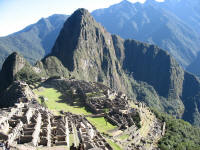
We entered the gate at Machu Picchu and followed the crowd up steep stone staircases. When we finally emerged, we had an incredible view of Machu Picchu. The sun had not yet risen above the steep mountain peaks, so the ruins were bathed in a soft, pre-dawn light. We took photos, then sat down on the grass to eat the last of our pop tarts while we waited for the sun to get above the mountain peaks, providing better light. By the time the sun crested the peaks, it no longer had the warm glow of morning light, but was a brilliant white. The sun would be the bane of our existence the rest of the day. We’d remembered sunblock, but not our hats. The sun was harsh, something about the thinner air, less atmosphere to diffuse it, I don’t know the exact science of it, but it was not a light winter sun. It was something else altogether.
Our tour lasted about two hours. Pedro and another guide at least had the foresight to divide the large group along English vs. Spanish speaking lines, so our tour was more thorough, since the guide didn’t have to say everything twice. We were told a lot, none of which I can recall as I sit here and write. Luckily Zac has a memory for such things, and he reports: Machu Picchu was originally built in the mid 1400’s and occupied for only 100 years; it was rediscovered by Hiram Bingham of Yale University in 1911. The city was “lost” because the retreating Incas abandoned the city and destroyed their trails. As a result the Spanish never found and plundered the site. The guide said that when it was found there were two families of farmers occupying the ruins. The guide also told us where the golden bracelet had been found and suggested that perhaps Hiram, who had also been in charge of the initial excavation, might have unofficially “borrowed” other precious treasures.
|
What Machu Picchu might have looked like in its heyday
|
|
 |
|
|
|
|
|
|
|
|
|
|
|
|
|
|
|
|
|
|
|
|
After our tour, we ate some snacks for lunch in the shade of one of the Incan houses. Then we headed in the direction where we thought the trail up Machu Picchu mountain began. On our way, we bumped into Maria, the girl I had met on the bus tour of the Sacred Valley. Since about 2,500 people visit Machu Picchu every day, I hadn’t actually expected to see here there. She helped us ask some guides about the trailhead to Machu Picchu mountain, but declined to climb it herself. So up we started. Up and up and up. It was a grueling hike. The air was somehow cool and hot all at once, like swimming in a lake where there are cold and hot spots. The sun was incredibly harsh, but luckily parts of the trail were shaded. The hardest part though, was breathing. Machu Picchu, although lower than Cusco, is still about 8,000 feet above sea level—the height at which altitude sickness can start to occur.
|
Lunch in an Incan house |
Machu Pichu Mountain in the background |
Sera with Maria and Rosanna |
the trailhead to Machu Picchu mountain |
|
Machu Picchu Mountain
A little ways up Machu Picchu mountain, we met a solo hiker, Allyssa. She was from Minnesota, but had just done a summer study abroad and homestay in Lima. She was traveling around a lot before heading home, trying to hit all the major sights. She joined us for the rest of the hike. We didn’t talk much on the way up, except on rest breaks, once we caught our breath. We had stunning views of the Machu Picchu ruins below, and lauded our choice of sleeping in until 5 and climbing this lightly-peopled mountain instead of the other one with 400 people. The summit was marked by a rainbow flag, reminiscent of the gay pride flag, but which was actually the Inca nation flag. As with most mountain climbs, the peak looks deceptively close, but is always out of reach. As we huffed and puffed our way up, hikers coming down would encourage us: “You’re about half way.” “Just 30 more minutes.” “You’re really close. It’s worth it!” It took us nearly two hours to reach the top, where the giant rainbow flag sailed merrily, effortlessly, in the wind.
The views were amazing. We could see snow capped mountains, Inca trails, the Machu Picchu ruins, the Urubamba river, and even some other Incan terraces built into the side of another mountain. We were alone at the summit for a few minutes, and then were joined by a couple from New York. We chatted about traveling while we ate snacks and drank our quickly diminishing supply of water. We spent a long time at the top, recuperating, and dreading the knee-paining descent. We stayed at the summit as long as we could afford to, what with three legs of a journey to complete that evening in order to end up sleeping in Cusco.
Going down, it was easier to breath, and we talked more with Allyssa. I recruited her for the Peace Corps as well, since she loved learning Spanish and enjoyed her homestay. My legs slowly turned to rubber, then jello, and my knees ached as they absorbed every shock. Four hours from when we had started, we were back at the Machu Picchu ruins. Most of the tourists had left already, and the ruins had a calm that had been sorely missed during the morning, when frenzied tour groups were all competing to see the main sights. We had a few minutes to spare, so we wandered around and took some photos of the llamas that were possibly employed as lawnmowers.
|
|
|
|
|
|
|
|
|
|
|
|
|
|
|
Pizza in Peru
We took a bus back down to Aguas Calientes, where were retrieved our backpack from our hostel and went to the Quipo restaurant to pick up our train tickets. We carefully scrutinized the times and dates, and were relieved that on his third try, Eddy got it right. We had some time before our train, so we ordered a pizza and a pitcher of Chicha Morada. I was dying of thirst and drank three glasses straight off. There are many pizza restaurants in Peru, but we had been eschewing them so far because we wanted to eat the local fare. However, we were growing tired of rice and cold vegetables, plus, we were intrigued by the fact that every pizza restaurant we saw had a wood-fired pizza oven. The pizza was indeed good.
We paid, then walked across the river to the train station. It was dark, so our train ride to Ollantaytambo and our bus ride from there to Cusco were devoid of the stunning views that had charmed our journey there. Since we couldn’t see anything, we listened to an audiobook of David Sedaris’s, When You are Engulfed in Flames, on the iPod.
Cusco
When our bus dropped us off at the Plaza de Armas in Cusco, Eddy was there waiting for us with the bus ticket to Puno. I examined it to verify that he had procured the right date and time. He then mentioned again the cost of the extra train ticket he had to get us, but also said it was his own fault. I’m sure he was hoping we’d offer to cough up the money, while at the same time knowing that we had no obligation to do so. Perhaps it was hard-hearted of us, and it still leaves me with an uncomfortable feeling, but we didn’t offer to pay. The whole situation had been a disaster and we were at least glad to be past it.
Back at our hostel in Cusco, we drank the complimentary tea and enjoyed the view overlooking the city. We were now in our third room at the same hostel. We had a private room, and were looking forward to a good night’s rest. Traveling is tiring, and our trip so far had been plagued by noisy nights and early mornings. All was going well until about 4 am, when the people in the room above us sounded like they were chasing mice while wearing ski boots. In reality, they were probably just packing up to leave, but the ceiling/floor was incredibly thin and the concrete and tile structure of the rooms amplified all of the sounds.
|
Sweet Potato Chips
Plaza de Armas at night
Our 3rd room at the hostel
|
   |
|


