|
Peru: Pisco
August 6-7, 2009

|
|
Arrival
The overnight bus ride was 12 hours long, and we were still dozing off and on when the bus attendant roused us, saying “Pisco, Pisco!” We were dumped at the side of the road, precisely as they had promised me we wouldn’t be. I need to be able to speak better Spanish. We were groggy and grumpy and succumbed to a predatory taxi driver’s wish that we pay him the equivalent of $5 to take us directly to our hostel in San Andres, a fishing village just south of Pisco. We were low on soles, and when he dropped us off, we asked if we could pay him $5. He said it was ok, but when we gave him the crisp greenback, he didn’t like it and refused. Our hostel owner came out and rescued us, paid off the driver, and ushered us inside.
Fanny led us to our room upstairs. It was larger than our first apartment in China, complete with a bedroom, bathroom, sitting room, kitchenette, and breakfast table. Although our quarters didn’t face the ocean, we were so close to the beach that we could still see the ocean out of both of our side windows. We’d come here as our last stop of the journey in order to take a boat tour out to some islands that were promoted as “the poor man’s Galapagos.” We needed to go back to Pisco to book the tour, get money from an ATM, purchase our bus ticket to Lima, and eat lunch. Fanny helped us get a colectivo—a shared taxi, into town. It only cost one sole each.
|
Our Hostel
View from the porch
View from our window
|
|
|
|
|
Pisco
Pisco was a decrepit, dusty town. In our trip so far, we’d never seen a place so ugly and run down. Buildings were crumbling, the cathedral in the main square had a collapsed dome, and many roads seemed to be under construction. San Andres had been the same way. We began to formulate a hypothesis that perhaps an isolated zombie apocalypse had occurred here. We were able to accomplish all of our errands in the area right around the square. For lunch we had salads with avocado and Zac had chicken and I had fish. We walked around a bit and bought a slice of pie, which we ate on a bench in the square. As awful as this town was, at least it had good pie. We wandered around some more and found a grocery store; it was cramped and messy. We got kicked out after a few minutes though, because they were closing, at 3pm! What kind of a place was this? We went back to the square and bought chocolate covered raisins from a candy vendor. After we seemed to exhaust all the activities and food-related entertainment around the square, and fearing to venture too far away from the center because the zombies might get us, we hopped in a colectivo and headed back to our hostel.
|
|
|
|
|
|
|
|
|
San Andres
We had to walk through a power-point presentation that was going on in the dining room of our hotel in order to get to our rooms. Not wanting to cross through there again, we holed up in our room reading books for a bit. After some time, we heard horns. Zac said, “It must be a parade.” I got up to investigate. “No,” I corrected, “a funeral.” The procession was large. A horde of pedestrians, carrying a casket, blocked all traffic in the road. I thought it was nicely symbolic of the way one feels when a loved one dies: Let the world stop, your errands don’t matter, nothing matters.
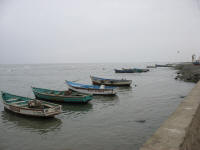
Eventually, we needed to go out and buy some water and scout out a place for supper. We went downstairs and luckily our hostel lady saw us and showed us an alternate exit so we didn’t have to walk through the meeting. We walked along the beach front, looking for a shop. Our fear of zombie mobs kept us from exploring the interior of the town. Everything was crumbling and deserted, but near the pier we found a shop selling water and snacks. We stocked up on water, fruit, cakes and bread. We sat and looked at the ocean to kill time until we could eat supper. It wasn’t a pretty beach. It was rocky and littered, and the same pall that hung over Lima also shrouded this area. The whole scene was dismal, and the wretched stray dogs, with matted coats and sores didn’t help.
We only found one restaurant open, and it was empty. There was a chalkboard sign outside advertising a set menu for ten soles, but the haughty waitress lady didn’t want to give it to us. She gave us an expensive menu, and we were preparing to walk out, on principle, because why advertise a ten soles menu if you’re not actually going to give it to your customers? My Spanish is poor, so I couldn’t adequately argue with her, but I tried one more time, saying “Why no menu?” She caved in, huffed back to the kitchen, and returned with what she could offer. We ordered what turned out to be fish fried rice. It was our grossest meal of the trip. Maybe the restaurant wasn’t that good, maybe they were punishing us for demanding to be given what the sign had advertised, I don’t know. The salad was good though, and she at least granted us a bottle of cusquena beer. We went to bed early.
Paracas
Friday was our last day in Peru, and we rose early for our tour to the Islas Ballestas. A tour van picked us up and took us to Paracas, further south along the coast. When we arrived at Paracas, the launch point for the tour, I was jealous. Clearly this was the town where all the tourist money was ending up. There were nice hotels and nothing was crumbling. I consoled myself by saying this was an artificial tourist town, and at least we were staying somewhere authentic. We were handed off to a tour agent and then to our guide. Sigh. We were back on the tourist treadmill. Busloads of other tourists were also arriving. Where were all these people staying? We’d seen hardly any tourists in Pisco or San Andres, and since they were arriving on busses, they couldn’t have stayed here in Paracas. Maybe they all stayed holed up in their hostels, also fearing the zombies.
While waiting in line to board our boat, our guide, Juan, asked us where we were from. When we said we were from the US, he gave a vivid description of his car not starting in Kansas and how the people there have pink cheeks in the winter. It turns out he had traveled quite a bit around the US, although I’m not sure why. Our group of 20 or so eventually boarded our boat, put on our giant orange life jackets, and zoomed toward the islands. Along the way, we passed the Candelabra, a giant geoglyph of mysterious origins on the side of a sand dune.
|
funeral procession
supper in an empty restaurant
|
|
|
|
|
Islas Ballestas
Although the islands were touted in our guide book as “the poor man’s Galapagos,” I quickly deemed them “the rich man’s zoo.” They were rocky outcroppings covered in birds—primarily sea gulls—but there were also boobies, cormorants, and the occasional Humboldt penguin and sea lion. Maybe I would have been more impressed if I hadn’t been at the Columbus Zoo three weeks prior. These small islands had nothing compared to the biodiversity of the Galapagos. Still, it made a fun excursion, and I only got pooped on once. Juan was ok as a guide, but typical—vast explanations in Spanish and then a short sentence or two in English, saying something banal like, “Penguins live for twenty years.” I’m not complaining, really, I just wish the touts would stop claiming that the guides would speak “excellent English.” They should just say, “The tour is primarily in Spanish, since most of our tourists speak Spanish, but the guide will speak a little English for you.” Maybe it is my fault for believing them every time.
|
|
|
|
|
|
|
|
|
|
|
|
Earthquake
Towards the end of the tour, Juan mentioned something about Paracas being all new, having been built after the earthquake. I was like, what? Earthquake? Suddenly it all made sense: the crumbling, desolate buildings, the construction…why hadn’t I thought of that? Juan said that the earthquake was two years ago. It must have happened after the most recent edition of Lonely Planet went to print, because it never mentioned an earthquake, and it’s usually pretty good about mentioning things like that. I looked it up when I got home, and sure enough, there had been an 8.0 magnitude earthquake centered in Pisco in August of 2007. No zombie apocalypse.
|
|
|
|
|
|
|
|
|
|
|
|
|
|
 |
|
|
|
San Andres
We were dropped off back at our hostel in San Andres, and we had time to find lunch before our 2:00 bus to Lima. We were definitely not going back to that awful restaurant from the night before, and on our ride down the coast, we’d noticed some restaurants just past the pier. We just hadn’t wandered far enough the night before. We decided to dine at the blue and yellow Restaurant Rosana, because there was a good amount of people there. We were tired of eating in restaurants alone. The fat waiter came over with an expectant look on his face. We said, “El menu.” He said, “pescado?” We said, “Si.” And it was as simple as that. Well, not really. He asked lots of other questions, and I would just hear the main word, like “soup” and I would say, “yes.” He could have been asking things like, “Would you like some extra hairy dog ears in your soup?” and I would say yes. It had been like this the whole trip, but the food always turned out good, so saying yes was never very dangerous.
He brought us a liter of Inka Cola and two bowls of chicken noodle soup to start. Zac began to eat his soup and he said, “Hey, I’ve got a foot in mine. And maybe a heart.” I countered, “I’ve got a foot in mine too. And I think this is the spinal column. And maybe some lungs.” We didn’t eat any of these body parts, but the soup was really good otherwise. Then he brought out two plates with a fried fish on each, some salad, and some rice. The fish had some bones and a tail. It was delicious. And the entire meal cost only 13 soles ($4.30). The cheaper the food, the better it is.
We walked back to our hostel, gathered up our bags, took a colectivo to Pisco, where the bus company put us in a taxi to the main road with a couple from Austria. Once we were deposited and waiting for the bus to Lima, the girl turned to me and asked, “So how did you like Pisco?” “It was awful!” I exclaimed. “Yeah,” she said, “we were supposed to stay two nights but we cancelled the second.” Our bus came shortly after 2:00, and we had a boring four hour trip up the desert coast. No more views of snow-capped mountains.
|
|
   |
|


